What counts as a job cost?
A job cost is one you wouldn’t have without the job: materials and parts installed on it, equipment rented for it, subcontractors and permits, and the travel, lodging and meals of a crew sent to it. Overhead keeps the company running whatever is on the schedule: the office, the shop and yard, general insurance, training, and the tools and trucks that move from job to job.
Some costs sit on the line: a saw blade worn out on one job’s slab, or protective gear one job’s hazards required, belongs to that job. Decide once, write it into your policy and code it the same way every time, or two similar jobs won’t compare.
How should you number jobs and cost codes?
Give every job a number before anyone buys for it, and every service call a work order. Inside a job, keep a short list of cost codes: the phases you price, such as rough-in, trim and fixtures, with a cost type on each line (labor, materials, equipment, subcontract or other). If your bids follow MasterFormat, the Construction Specifications Institute’s standard for organizing specifications into work results, borrow its numbers so job costs line up with the bid.
Keep the list short enough to remember at the counter: a code nobody remembers becomes miscellaneous, and miscellaneous can’t say why a job ran over.
How do you get the job number onto every receipt and drive?
At the supply house, buy on the company’s account and give the job or purchase order number at the counter so it prints on the ticket; ask each supplier to require one. On a personal card, the rule is a photo of the itemized receipt the same day, with the job number: a receipt found in a truck door three weeks later has usually lost its job.
For drives, put the job or work order in the purpose, which a mileage record needs anyway (IRS Publication 463, Table 5-1).
What if one purchase serves two jobs?
Split it by what each job used and write the split on the receipt: a $64 box of 50 fittings, 30 used on one job and 20 on another, is $38.40 and $25.60. Better still, ask the counter for a ticket per job.
How should materials be billed on time-and-materials work?
At the price the contract or work order sets: at cost, or at cost plus the markup it states. Bill from the receipts, so every material line has a ticket behind it, and code receipts before your billing cutoff, or a part bought on the 29th can miss the month’s invoice. Credit returns to the same job, and send a customer who asks for backup the ticket itself.
Tools or materials: who pays?
Materials are used up on a job; tools are kept. Repay tools against receipts under your accountable plan: a flat tool allowance paid without proof of what was spent, or without returning the excess, is taxable wages (Rev. Rul. 2005-52), and so is a tool payment that replaces part of someone’s hourly pay (Rev. Rul. 2012-25).
If you require workers to bring their own tools, the cost can’t cut into the minimum wage or overtime owed to non-exempt staff in any workweek (29 CFR 531.35). In California, the employer provides the tools on-site construction work requires, though employees paid at least twice the minimum wage may provide hand tools customarily required by their trade (IWC Order 16-2001, section 8(B)).
Who pays for safety gear?
The employer, for the protective equipment OSHA standards require: it’s provided “at no cost to employees” (29 CFR 1926.95(d) in construction, 1910.132(h) in general industry), and it must fit each worker. The exceptions are narrow: non-specialty safety-toe boots and prescription safety glasses the employer lets workers wear off the job site, everyday clothing, and ordinary weather gear. Replacements are the employer’s cost too, unless the worker lost the gear or damaged it on purpose.
So approve required gear without a limit, never take it out of pay, and code it to overhead or to the job whose hazard required it.
Which drives count as business miles?
Pay business miles at the IRS rate for the date of the drive: 72.5 cents a mile through June 30, 2026 (Notice 2026-10) and 76 cents from July 1 (Announcement 2026-11). The rate covers fuel, so don’t pay for gas on top; business parking and tolls are paid separately (Publication 463).
Drives between job sites count, and so do supply runs; the first and last trips are the question. Home to a regular work location, such as a shop a tech reports to, is commuting however far it is, even hauling tools (Publication 463), and the shop to a job site counts.
Home to a job site
A job site is a temporary work location when work there is realistically expected to last, and does last, a year or less. Under Rev. Rul. 99-7, someone with a regular work location away from home can count the drive between home and a temporary site “regardless of the distance”; someone without one, only when the site is outside the metropolitan area where they live and normally work. A site expected to run longer than a year isn’t temporary.
Whether a yard a crew passes through each morning is a regular work location is a judgment the ruling leaves open; ask your tax adviser before paying home-to-site miles tax-free.
Company vehicles and drive time
A company van taken home earns no mileage, and its commuting use is taxable unless it’s a qualified nonpersonal use vehicle, such as a van marked with the company’s name, seating two at most, with permanent shelving filling most of the cargo area (IRS Publication 15-B). For non-exempt staff, driving between job sites, or from the shop after picking up tools, is paid work time (29 CFR 785.38).
When is per diem for a traveling crew tax-free?
A crew is traveling away from home when a job keeps it away from the area of its tax home, usually its regular place of work, long enough to need sleep or rest (Publication 463); its lodging, meals and travel are business expenses while the job is temporary. A job realistically expected to last more than a year is indefinite: its location becomes the tax home, and anything paid for living there is wages, even if it’s called a travel allowance, from the day the job is expected to run past a year.
Per diem pays a daily amount in place of meal receipts, and of lodging receipts if it covers lodging. Under an accountable plan, it counts as substantiated up to the federal rate for the place the crew sleeps (Rev. Proc. 2019-48); anything above that is wages. GSA’s standard rates for October 1, 2026 to September 30, 2027 are $113 a night for lodging and $68 a day for meals and incidentals, and 295 places have their own (GSA Bulletin FTR 27-01). On the days a crew leaves and returns, the meals rate can be prorated to 75%, $51 at the standard rate (GSA). The IRS high-low alternative is $329 a day in high-cost places and $230 elsewhere (Notice 2026-60).
Workers still record each trip’s dates, place and purpose. Pay per diem only for days away, never to someone who lives near the job, and never in place of wages: per diem that keeps total pay the same whether or not someone travels is wages (Rev. Rul. 2012-25).
What records does an accountable plan need?
Three things: each expense is for the business, it’s accounted for within a reasonable time, and any excess comes back. Then reimbursements stay out of wages and payroll taxes, and 60 days to account and 120 days to return any excess count as reasonable (Treas. Reg. 1.62-2).
For materials, parts and tools, the record must identify the specific nature of each expense, so “miscellaneous business expenses” won’t do (1.62-2(e)(3)); an itemized ticket with the job number will. For travel, keep a receipt for every night of lodging and every other expense of $75 or more (Treas. Reg. 1.274-5(c)(2)(iii)). For each drive, record the date, destination, purpose and miles; amounts you “approximate or estimate” don’t count (Publication 463).
Does job costing matter for taxes?
For contracts that run past year-end, it can. A construction contract not completed in the tax year it’s entered into is a long-term contract, and its income generally must be reported by percentage of completion, comparing the costs allocated to it so far with its estimated total costs (26 U.S.C. 460). Residential construction contracts are exempt, and so are other construction contracts expected to be finished within two years by a contractor with average annual gross receipts of $32 million or less over the three prior tax years, for tax years beginning in 2026 (Rev. Proc. 2025-32). Which method applies is for your tax adviser; your bids and margins need each job’s costs either way.
What does a contractor’s week look like?
A 14-person electrical contractor has two jobs running in the week of October 19, 2026: job 2614, a tenant fit-out across town, and job 2617, a school renovation 140 miles away, expected to take five months, in a county at the standard federal rates. Two electricians stay there Monday to Thursday in rooms the company pays for, on per diem for meals; a service tech who reports to the shop runs two calls in his own pickup.
| Expense | Job | Amount |
|---|---|---|
| Wire and boxes, supply-house account | 2614 | $1,284.50 |
| Scissor lift, three days | 2614 | $465.00 |
| Fittings, own card, 30 of 50 | 2614 | $38.40 |
| Fittings, own card, 20 of 50 | 2617 | $25.60 |
| Motel, 2 rooms × 3 nights × $104 | 2617 | $624.00 |
| Per diem, 2 × ($51 + $68 + $68 + $51) | 2617 | $476.00 |
| Breaker, own card | WO 5531 | $86.40 |
| Shop to WO 5531 and back, 22 miles × $0.76 | WO 5531 | $16.72 |
| Outlet and cover plate, own card | WO 5534 | $12.60 |
| Shop to WO 5534 and back, 12 miles × $0.76 | WO 5534 | $9.12 |
| Hard hat, a cracked one replaced | Overhead | $38.00 |
| Cordless drill, a broken one replaced | Overhead | $179.00 |
The week cost $3,255.34: $1,787.90 on job 2614 ($1,284.50 + $465.00 + $38.40), $1,125.60 on job 2617 ($25.60 + $624.00 + $476.00), $103.12 and $21.72 on the two work orders and $217.00 of overhead. Employees were paid back $881.84 for their own-card purchases, per diem and drives; the other $2,373.50 went on company accounts.
The work orders bill parts at cost plus the 15% markup in their service agreements: $99.36 for the breaker and $14.49 for the outlet. The tech’s drives from home to the shop are commuting, so they aren’t in the table. Job 2617 should take five months, so its per diem is tax-free; expected to take fourteen, it would be wages from the first day. (The company, its jobs and the numbers are made up.)
Do any states require you to reimburse work expenses?
California’s Labor Code section 2802 requires employers to indemnify employees for “all necessary expenditures or losses” incurred in direct consequence of their duties, and an agreement to waive it is void (section 2804); Montana (39-2-701) and South Dakota (60-2-1) say much the same. Illinois (820 ILCS 115/9.5) requires repaying necessary expenditures claimed within 30 days, unless a written policy allows longer, but not losses from an employee’s own negligence, normal wear, or theft the employer’s negligence didn’t cause. Iowa (91A.3) and New Hampshire (RSA 275:57) give employers 30 days to repay expenses they authorized or asked for. None sets a mileage rate or a per diem, and other states and cities may have rules of their own; ask employment counsel.
How does ExpenseOS™ handle expenses by job?
Receipts are snapped, uploaded or emailed to each person’s own receipts address, read for the merchant, amount and category, and checked against your policy before they’re sent, with the rule named. People can ask first, “Will this be approved?” in the chat, and get an approval in advance.
There’s no job field on a receipt or a drive yet: the job number the supply house prints stays on the ticket, and a drive’s purpose holds the work order. Drives are worked out from their start and end addresses at the IRS rate on the date of the drive, or your own. A crew’s out-of-town travel can be filed to a trip that keeps its lodging, meals and drives together, its budget approved before anyone leaves; per diem at GSA rates is coming.
Someone on your finance team, in the Accountant role, gives each approved expense its GL code and one cost center, where contractors put the job or work order.
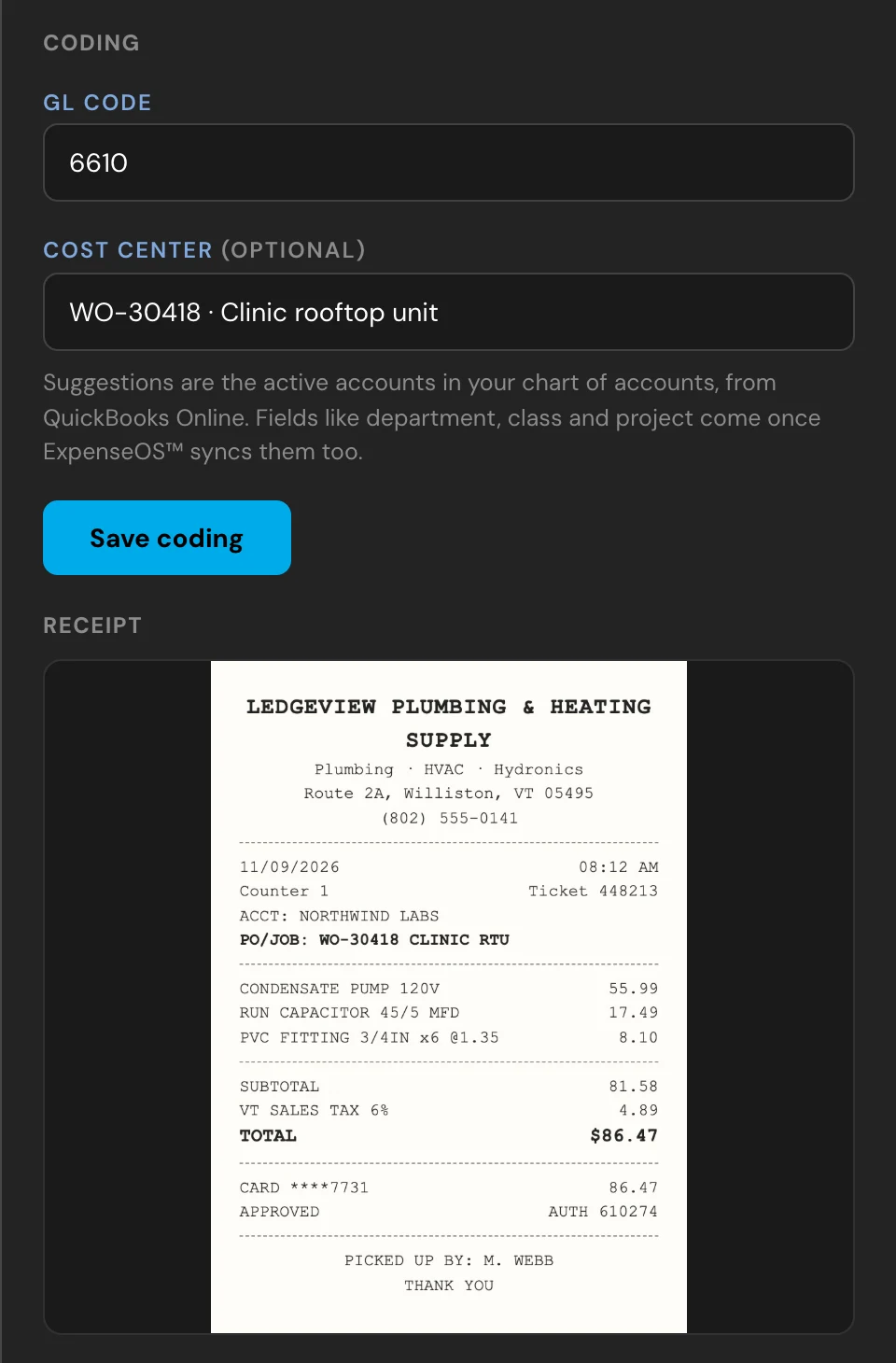
A real screen from the app: parts for a service call coded to the work order printed on the supply-house ticket.
Expenses inside your policy approve themselves; the rest go by your approval levels to the approvers you name, with the receipt and what was checked. Once approved, the money is in the employee’s ExpenseOS wallet within a minute, ready to move to their bank in one to three business days.
Expenses export as CSV or Excel, and coded ones post to QuickBooks, Xero, NetSuite, Sage Intacct and Microsoft Dynamics. One expense carries one cost center: splitting a receipt across jobs isn’t built, and job, class or project fields in your accounting system aren’t synced yet. How field service and construction companies use ExpenseOS →
This guide is general information as of 9 November 2026, not legal or tax advice. Check your policy with a tax adviser and, for wage, safety and state rules, employment counsel.