What does tracking expenses by program and funding source mean?
Every expense answers three questions, each with its own code: which program or activity it served, which function it is on Form 990 (program services, management and general, or fundraising), and whose money pays for it (unrestricted funds, a private grant or a federal award). One answer doesn’t decide another: a program can be paid for partly by a grant and partly by unrestricted funds, and a donor dinner is fundraising whichever fund pays. Code all three as the expense comes in.
What are the three functional expense categories?
They’re the columns of Form 990’s Statement of Functional Expenses (Part IX), and section 501(c)(3) and 501(c)(4) organizations filing Form 990 must complete all of them (IRS, Instructions for Form 990). Form 990 is required once gross receipts reach $200,000 or total assets $500,000, private foundations aside.
| Column | What goes in it |
|---|---|
| Program services | Activities that “further the organization’s exempt purposes”: the programs, and the staff time and travel spent on them |
| Management and general | Overall operations: the chief executive’s office, board meetings, accounting, auditing, human resources, general legal costs |
| Fundraising | Soliciting contributions, gifts and grants, from donor cultivation to grant proposals for services to the public |
Fundraising is never program, “even though one of the organization’s purposes is to solicit contributions.” Soliciting grants to serve the public is fundraising too, while securing a grant or contract to meet the grantor’s own specific needs is program. State reports can draw the lines differently.
How do you allocate a shared expense across programs?
By a reasonable method you write down and use every time: the IRS accepts any reasonable method but asks you to “document the method of allocation” in your records. In its example, an employee who spends 40% of the time on fundraising and 60% on program management is split 40/60, not called all program (Form 990 instructions, Part IX).
Time suits people and their travel; miles, space or headcount suit other costs. On a federal award, a cost shared by two or more projects is allocated by proportional benefit where that can be measured “without undue effort or cost,” and otherwise on “any reasonable documented basis” (2 CFR 200.405(d)).
What are restricted funds, and what do they change?
For organizations that follow ASC 958, Form 990’s balance sheet splits net assets in two, the standard’s classes since Accounting Standards Update 2016-14 (Part X). Net assets with donor restrictions come from gifts a donor limited to a purpose or a time, or asked you to invest permanently; everything else is without donor restrictions, “regardless of the existence of any board designations,” so a reserve your board sets aside is still unrestricted.
A restriction changes which money may pay for an expense, not what the expense is. Put the funding source on every expense charged to a restricted gift or grant, so finance can show the money met the donor’s purpose; how the release is booked is for your auditor.
Why keep unrestricted funds, private grants and federal awards apart?
Unrestricted funds
Your own policy and board decide. This money pays for what grants won’t, such as a donor dinner, as long as your policy allows it.
Private grants
The agreement decides: its budget lines, what it repays, any travel limits, what you report. The federal cost rules don’t reach a private grant on their own; they’re written for federal awards (2 CFR 200.101). But an agreement can copy them, and federal money a foundation passes to you to carry out part of a federal award is a subaward.
Federal awards and subawards
2 CFR 200, the Uniform Guidance, governs federal awards, and its terms “flow down to subawards to subrecipients” (200.101(b)). A cost charged to one must be necessary, reasonable and allocable, consistent with “policies and procedures that apply uniformly to both federally financed and other activities,” and “adequately documented” (2 CFR 200.403). Your records must show “the amount, source, and expenditure of Federal funds,” and you need written procedures for deciding what’s allowable (200.302(b)).
Some costs it won’t pay: “The cost of alcoholic beverages is unallowable” (200.423), and so are promotional items and memorabilia (200.421(e)), organized fundraising, unless the agency approves it in writing for the program’s objectives (200.442), and entertainment, unless it has “a specific and direct programmatic purpose” and is included in the award (200.438). Unrestricted funds can pay for them where your policy allows.
Purchases above your micro-purchase threshold, the FAR’s $15,000 unless you document another, need price quotes, or formal bids above the simplified acquisition threshold (200.320; FAR 2.101), and equipment it buys, lasting over a year and costing $10,000 a unit or your lower capitalization level, needs property records (200.1; 200.313). This is the 2024 revision, in effect since October 1, 2024; an older award may follow the earlier text (89 FR 30046).
How should travel on a federal award be handled?
By your written travel policy, applied to all your travel alike. Costs may be actual, per diem or mileage, or a combination, “provided the method used is applied to an entire trip and not to selected days of the trip.” Lodging and meals are allowable only up to what your policy normally allows, and charged directly to an award, they need records showing the traveler was needed (2 CFR 200.475).
Without a written policy, federal rates apply: from October 1, 2026, $113 a night and $68 a day for meals and incidentals in most of the continental US, more in 295 places (GSA Bulletin FTR 27-01). Airfare above “the basic least expensive unrestricted accommodations class” needs a documented reason the rule lists, such as a medical need, and federally funded flights use U.S. flag carriers, with listed exceptions (41 CFR 301-10.132).
How should a nonprofit reimburse employees?
Under an accountable plan: each expense is for the organization’s business, substantiated within a reasonable time, and any excess returned. Reimbursements then stay out of W-2 wages, and 60 days to account and 120 to return any excess count as reasonable (Treas. Reg. 1.62-2); a flat allowance paid regardless of spending is wages. Your tax exemption doesn’t change this. Each expense needs:
| Record | Why |
|---|---|
| Date, amount and merchant, with a receipt | A receipt for lodging and any other travel expense of $75 or more (Treas. Reg. 1.274-5); for other purchases, enough to show “the specific nature of each expense” (1.62-2(e)(3)) |
| Business purpose, and a meal’s attendees | The accountable plan, and whether the meal is program or fundraising |
| Program, function and funding source | The cost center, Form 990’s columns, and federal records of each award’s “amount, source, and expenditure” |
| Approver and date | Your written procedures for what’s allowable |
Officers and directors
Schedule J filers (for example, when someone listed in Form 990, Part VII, had over $150,000 of reportable and other compensation) report whether they paid first-class, charter or companions’ travel for those people, whether a written policy covered it, and whether they required substantiation first (Schedule J instructions). Business class isn’t first class there; a family member’s travel is companion travel even on business. Directors repaid as an accountable plan would repay staff get a working condition fringe; payments without adequate accounting “are compensation.”
What mileage rate should a nonprofit pay staff in 2026?
The IRS business rate for the date of the drive: 72.5 cents a mile through June 30, 2026 (Notice 2026-10), and 76 cents from July 1 (Announcement 2026-11). Pay more and the excess is wages (Publication 463). Paying less is allowed by tax law, but some states require necessary expenses repaid, and for non-exempt staff, required costs can’t cut into minimum wage or overtime (29 CFR 531.35).
Office to community sites, site to site, and errands such as the bank count; home to your regular office is commuting, “no matter how far your home is from your regular place of work” (Publication 463). Pay business parking and tolls on top, and log each drive’s date, destination, purpose, miles, program and funding source.
Can you reimburse volunteers the same way?
No. The accountable-plan rules are written for employees. A volunteer can deduct unreimbursed driving as a charitable contribution, and for that “the standard mileage rate shall be 14 cents per mile” (26 U.S.C. 170(i)), a rate fixed by law (Announcement 2026-11). Costs you repay can’t be deducted (Treas. Reg. 1.170A-1(g); Publication 526).
Repaying a volunteer’s actual costs, such as gas and oil, isn’t income to them. But when an agency paid volunteer drivers the business rate, the IRS wrote that “the excess over the 14 cent charitable rate is income to the recipient” (INFO 2000-0031), since a volunteer can generally exclude only repayments of costs they could deduct (INFO 2005-0135), and that the payer may have information returns to file (INFO 2000-0049). Information letters are “advisory only” (Rev. Proc. 2026-1), but they show the IRS’s view.
So the rates aren’t interchangeable: 76 cents is for employees’ business driving, 14 cents for a volunteer’s deduction. Give volunteers their own policy, and ask a tax adviser before paying them per mile.
How do you keep donor events and fundraising apart from programs?
Code meals and events with donors, prospective donors and funders you’re asking for money to fundraising, and pay with money that allows it, usually unrestricted funds: a federal award won’t, and a private grant only if its agreement says so. Material about the organization itself or its use of past contributions is fundraising too, even in a mailing that educates (Part IX, line 26).
A benefit with ticket sales is reported differently: its direct costs, such as the food, go on Part VIII, line 8b; its advertising, in the fundraising column. Travel or entertainment for a public official is reported once spending on that official passes $1,000 for the year (line 18). And code by purpose: a meal with a partner to plan program work is program.
What does a community nonprofit’s month look like?
Northside Reads, a community nonprofit in Seattle, has two programs: youth literacy, paid for by an Alder Foundation grant covering books, supplies and local travel, and adult education, paid for by a federal award it receives through its state, a subaward. Its written travel policy pays actual costs for whole trips, room rates up to the federal lodging rate before taxes and meals up to the city’s federal meals rate, with no alcohol on either grant. In October 2026:
| Expense | Coded to | Amount |
|---|---|---|
| Books and supplies for the reading clubs | Youth literacy · Alder grant | $612.40 |
| Drives to three reading clubs, 84 miles × $0.76 | Youth literacy · Alder grant | $63.84 |
| Drive to the Eastside Center, half of 20 miles × $0.76 | Youth literacy · Alder grant | $7.60 |
| The same drive, the other half | Adult education · federal award | $7.60 |
| Conference registration, Chicago | Adult education · federal award | $495.00 |
| Economy flight to Chicago and back | Adult education · federal award | $318.00 |
| Hotel, two nights at $219 plus taxes | Adult education · federal award | $514.20 |
| Meals ($144) and airport rides ($46) | Adult education · federal award | $190.00 |
| Dinner with two major donors, wine included | Fundraising · unrestricted | $236.80 |
| Lunch for the board meeting | Management and general · unrestricted | $96.00 |
The month’s expenses total $2,541.44. By program: youth literacy $683.84 and adult education $1,524.80, so program services come to $2,208.64; fundraising is $236.80 and management and general $96.00. By funding source: the Alder grant $683.84, the federal award $1,524.80 and unrestricted funds $332.80.
The Chicago trip fits the policy: $219 a night against Chicago’s October federal rate of $232, and meals under $92 a day (GSA). Form 990 puts the registration on its conference line and the trip on its travel line, both program services. The Eastside drive is split by hours, two with each program. The dinner’s $48 of wine stays off both grants, and the board lunch is management and general, the column for “costs of board of directors meetings.” (Northside Reads, the Alder Foundation and the numbers are made up.)
What records should you keep, and for how long?
Keep receipts, logs and approvals with each expense, and the basis for every split. The IRS generally asks for three years from filing the return, and at least four for employment tax records (IRS). Federal award records stay three years from the final financial report, longer if an audit, claim or litigation starts first (2 CFR 200.334), and spending $1,000,000 or more of federal awards in a fiscal year brings a single or program-specific audit (200.501). Grant agreements may ask for more.
Do any states require nonprofits to reimburse employees?
California’s Labor Code section 2802 requires employers to indemnify employees for “all necessary expenditures or losses” incurred in direct consequence of their duties, and a waiver is void (section 2804); Montana (39-2-701) and South Dakota (60-2-1) say much the same. Illinois (820 ILCS 115/9.5) requires repaying necessary expenditures submitted within 30 days unless a written policy allows longer, and a policy’s limits can’t amount to “no reimbursement or de minimis reimbursement.” New Hampshire (RSA 275:57) gives 30 days to repay expenses an employer asked for. None sets a mileage rate; ask employment counsel.
How does ExpenseOS™ handle nonprofit expenses?
Staff ask first: “Will this be approved?” in the chat, with the purpose, supplier, amount, date, category and how it’s paid. ExpenseOS answers against your policy and names the rule. Inside the policy, it’s approved in advance at once; otherwise an approver, by your approval levels, by amount or one person you name, sees why and what was checked, and decides before anyone pays. Paid on their own card within that approval, the receipt then goes through on its own.
Receipts are snapped, uploaded or emailed, read for the merchant, amount and category, and checked against your policy with the rule named; expenses inside it approve themselves, and the rest go to the approver. Drives are priced from their addresses or typed miles, at the IRS rate on the date of the drive or your own. Approved expenses reach the employee’s ExpenseOS wallet within a minute.
A trip billed to a funder’s code follows that funder’s travel policy for travel booked for it, and the code goes on those bookings, not on receipts or drives filed to the trip. Someone on your finance team, in the Accountant role, gives each expense a GL code and one cost center, where nonprofits put the program or grant; expenses export as CSV or Excel, and coded ones post to QuickBooks, Xero, NetSuite, Sage Intacct and Microsoft Dynamics.
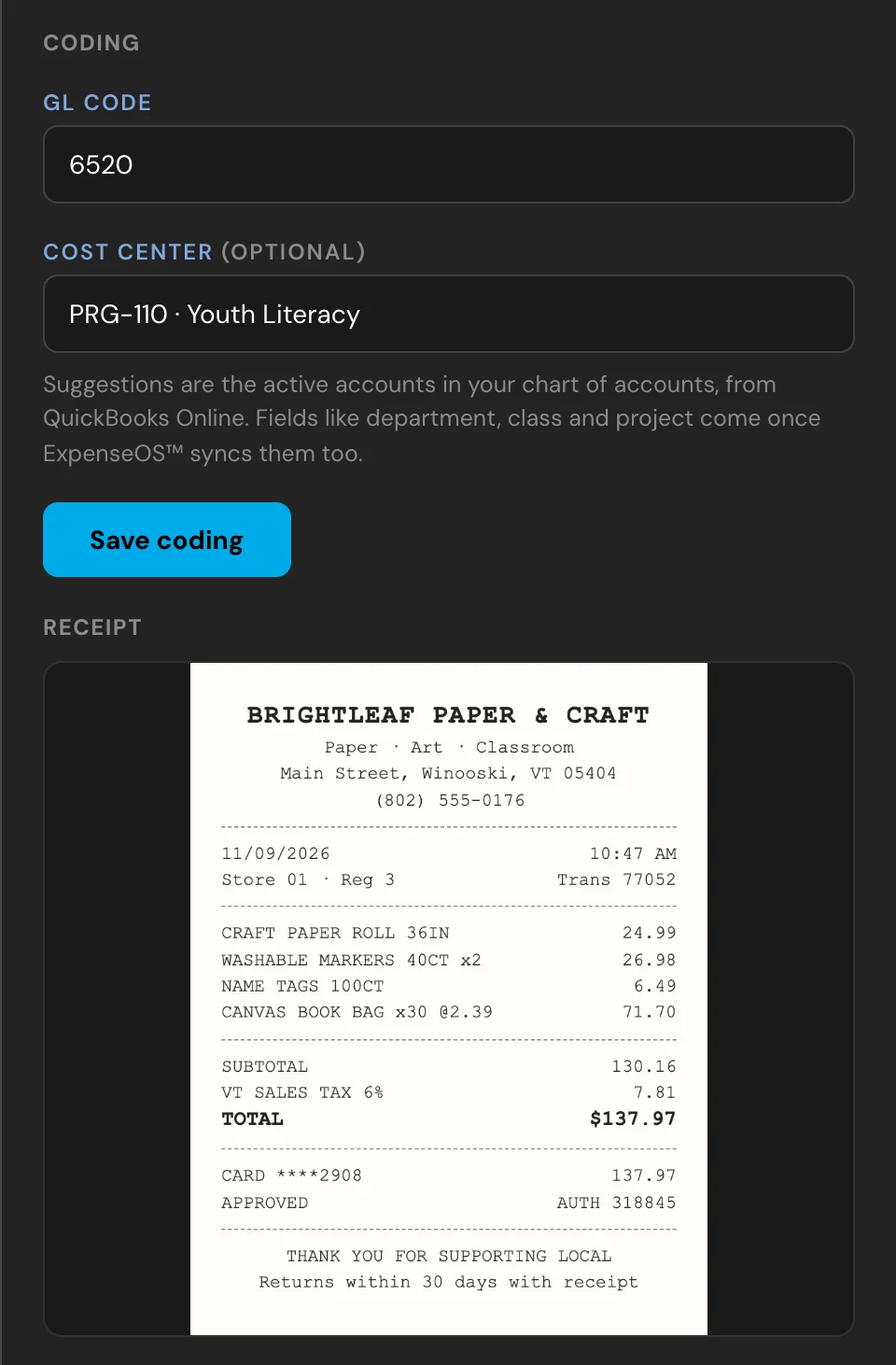
A real screen from the app: a program purchase coded with the program as its cost center.
An expense can’t be split across programs, and fund, class or project fields aren’t synced yet, so finance records splits, function and fund in its accounting system. The nonprofit pack keeps donor and partner meals apart from program meals, and every policy change is previewed, confirmed and logged. ExpenseOS doesn’t repay volunteers, keep fund accounts, manage or report on grants, prepare Form 990 or decide what a grant allows; per diem at GSA rates is coming. Travel and expense management for nonprofits →
This guide is general information as of 9 November 2026, not legal or tax advice. Check your policy with your auditor and a tax adviser, your grant agreements with each funder and, for state rules, employment counsel.