What is the IRS mileage rate for 2026?
2026 has two business rates. The IRS set 72.5 cents a mile in Notice 2026-10, then raised it to 76 cents from July 1 in Announcement 2026-11, citing “recent increases in the price of fuel.”
The date of the drive decides the rate. A June 30 drive stays at 72.5 cents even if you reimburse it in July, so a log that runs across the summer needs both rates. The IRS hadn’t published a 2027 rate when this guide was written.
The IRS rate isn’t mandatory, but it is the ceiling for a tax-free per-mile rate: anything you pay above it is taxable wages (IRS Publication 463). And reimbursing matters more than it used to. A 2025 federal law made permanent the rule that employees can’t deduct unreimbursed employee travel expenses, with narrow exceptions (Notice 2026-10), so any business mile you don’t pay for is a cost your employee absorbs.
Which drives count as commuting?
Driving between home and your regular place of work is commuting, and “You can’t deduct commuting expenses no matter how far your home is from your regular place of work” (Publication 463). Taking work calls on the way doesn’t change that, and neither does hauling tools.
Once someone is at work, driving to another place of work is business: if you work at two places in one day, “you can deduct the expense of getting from one workplace to the other.” Business errands during the day, such as a run to a supply store or the bank and back, count too.
You can still pay for commuting, but that money is taxable pay, because reimbursing an expense that isn’t deductible falls outside an accountable plan (Treas. Reg. 1.62-2(d)(2)).
How do the rules apply to each role?
Maintenance technicians and leasing agents at one property
Home to the property is commuting, however far. The property to a supply store, the bank or a sister property, and back, is business. After-hours call-outs are the hard case: a call-out from home to the tech’s own property is still a trip between home and the regular place of work, and Publication 463 makes no exception for it. If you pay those miles, run them through payroll as wages unless your tax adviser concludes otherwise.
Community managers who cover two or three properties
Each property they work at regularly is a regular place of work, so the first drive from home and the last drive home are commuting, and every drive between properties counts.
Regional managers who visit the same properties every week
A property you expect to keep visiting for more than a year isn’t a temporary work location, so treat it as a regular place of work: drives between it and home are commuting. If the day starts at a regional office, the drive from the office to the first property counts. With no office at all, Publication 463 treats the first business stop as the office, so the first and last legs are commuting and everything between counts. If a home office qualifies as the principal place of business (IRS Publication 587 has the test), drives from home count.
Staff sent to another property for a while
If someone with a regular place of work is sent to another property for an assignment realistically expected to last a year or less, such as a lease-up, the drive between home and that property counts “regardless of distance” (Publication 463, following Rev. Rul. 99-7). If it’s expected to last longer, it isn’t temporary, and the drive is commuting. Floating staff with no regular place of work are different: home to a site inside their metropolitan area is commuting, only sites outside it count from home, and drives between sites count.
What about several stops in a day?
Every business leg counts, and one record can cover “a round trip or uninterrupted business use,” says Publication 463; a lunch stop between two business stops doesn’t interrupt it. A personal detour does limit the claim: pay no more than the direct route from one workplace to the next would have cost.
Are parking and tolls paid on top of mileage?
Yes, when they’re for business. Publication 463 allows business-related parking fees and tolls in addition to the standard mileage rate, so reimburse them as their own lines. Parking at your regular place of work is commuting. Don’t pay for gas on a personal car as well: the per-mile rate already stands in for the cost of running the car, fuel included.
What does a regional manager’s day of driving pay?
Maya is a regional manager. Most mornings she reports to her company’s regional office, then visits the properties she oversees, the same ones every week. Her company pays the IRS rate. On Tuesday, July 14, 2026, she drove six legs:
| Leg | Miles | Paid? | Why |
|---|---|---|---|
| 1. Home to the regional office | 14 | No | Commuting to her regular place of work |
| 2. Office to Maple Court | 9 | Yes | One workplace to another |
| 3. Maple Court to Riverside Commons | 13 | Yes | Between properties (plus a $2.50 toll) |
| 4. Riverside Commons to a supply store | 4 | Yes | Parts for a unit turn |
| 5. Supply store back to Riverside Commons | 4 | Yes | The errand’s return |
| 6. Riverside Commons to home | 18 | No | She works there every week, so the drive home is commuting |
She drove 62 miles. The business miles are legs 2 to 5: 9 + 13 + 4 + 4 = 30 miles. At 76 cents, 30 × $0.76 = $22.80, plus the $2.50 toll = $25.30. Had the same day fallen on Tuesday, June 16, 2026, before the rate changed: 30 × $0.725 = $21.75, plus the $2.50 toll = $24.25.
Had she driven from home straight to Maple Court, that first leg would have been commuting too. Had Riverside Commons been a property she was covering for three months rather than a weekly stop, the 18 miles home would have counted, because she has a regular place of work and the assignment is temporary. (The miles and the properties are made up.)
What does a mileage log have to record?
For each business drive: the date, the destination, the business purpose and the miles. Paying a standard rate doesn’t remove that duty (Treas. Reg. 1.274-5(j)(2); Publication 463, Table 5-1). Start and end addresses make the miles easy to check.
Record drives near the time. Publication 463 accepts a log kept weekly or on a computer, and rules out amounts you “approximate or estimate.” The accountable-plan safe harbor is to account for each expense within 60 days and return any excess within 120 days (Treas. Reg. 1.62-2(g)). Employees who hand their records to the employer and are reimbursed generally don’t need to keep copies, so your system holds the record.
Should you pay mileage or a car allowance?
Pay per mile under an accountable plan if you want the money to reach staff tax-free. An accountable plan has three rules: each expense has a business connection, the employee accounts for it within a reasonable time, and any excess is returned. Payments under one stay out of the employee’s income and W-2 wages, with no withholding or employment taxes (Treas. Reg. 1.62-2(c)(4)). Paying up to the IRS rate for each logged business mile fits.
A flat car allowance doesn’t. If you pay an amount “regardless of whether the employee incurs” business expenses, everything paid under the arrangement is treated as paid under a nonaccountable plan (Treas. Reg. 1.62-2(d)(3)): it’s wages, on the W-2, with taxes withheld. A $300 monthly allowance reaches the employee as $300 less tax, whether they drove 50 business miles that month or 500. The IRS’s structured alternative is a fixed and variable rate (FAVR) plan, which has its own rules.
Do any states require you to reimburse work expenses?
Federal tax rules decide what you can pay tax-free, not whether you must pay; some states decide that. California’s Labor Code section 2802 requires employers to indemnify employees for “all necessary expenditures or losses” incurred in direct consequence of their duties, and Montana (39-2-701) and South Dakota (60-2-1) impose the same duty in similar words. Illinois (820 ILCS 115/9.5) requires reimbursing necessary expenditures within the scope of employment, submitted within 30 days unless a written policy allows longer; a written policy can set limits, as long as it doesn’t provide for no or de minimis reimbursement. Iowa (91A.3) and New Hampshire (RSA 275:57) require expenses the employer authorized or asked for to be repaid within 30 days of the employee’s claim or proof of payment.
None of these laws sets a per-mile rate, and other states and cities may have rules of their own, so ask employment counsel how your policy meets the ones where your staff work.
How does ExpenseOS™ handle mileage?
An employee logs a drive, such as the office to Maple Court, and ExpenseOS works out the miles from the two addresses and pays them at the rate in effect on the date of the drive, the IRS rate or your company’s own, so a June drive filed in July is still paid at June’s rate. If your rate is above the IRS rate, the drive shows how much of it is above and may count as taxable income.
Expenses inside your policy approve themselves; anything else goes to a manager with what was checked. Once a drive is approved, the money lands in the employee’s ExpenseOS wallet within a minute, ready to move to their bank in one to three business days.
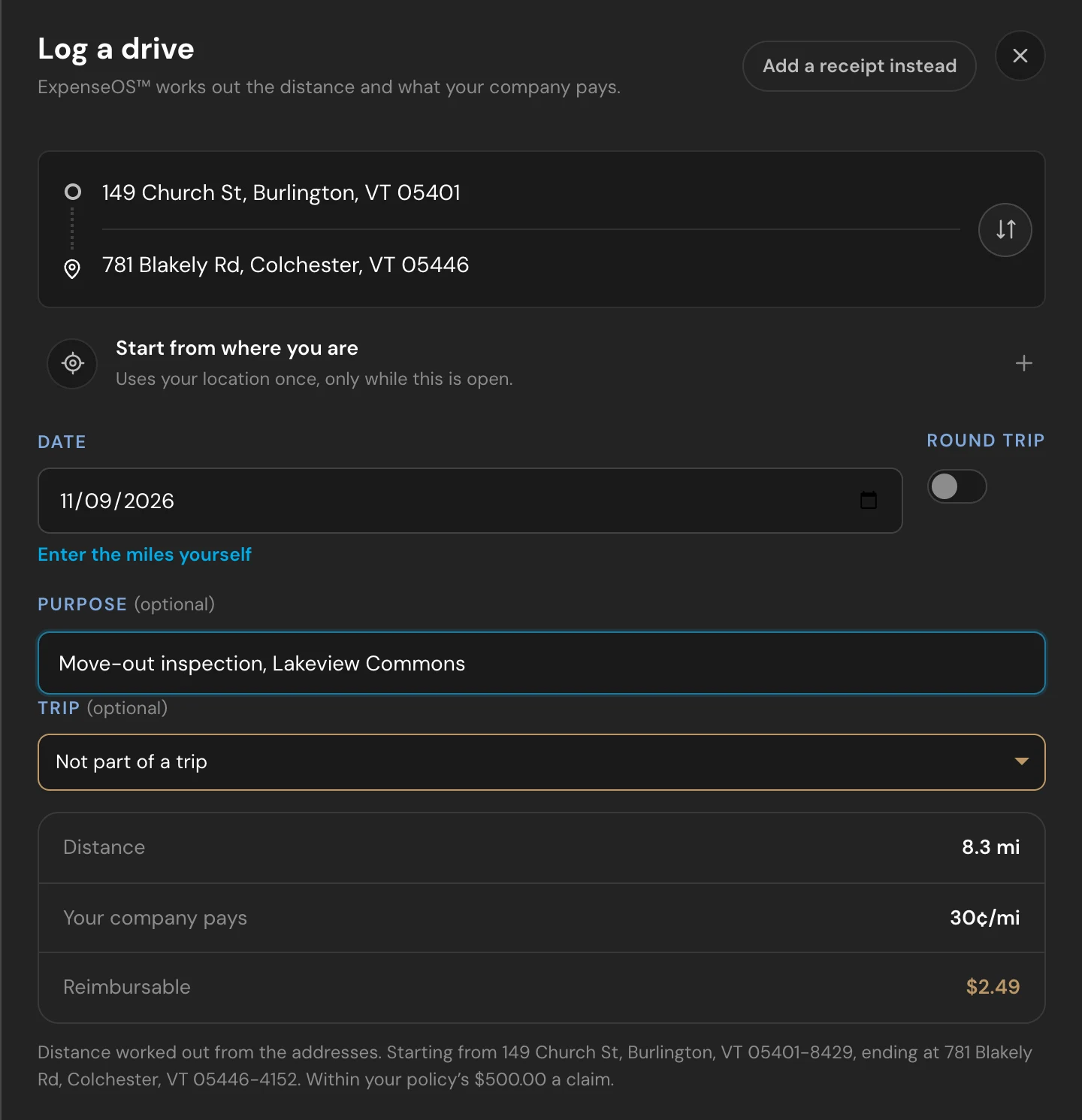
A real screen from the app: a drive between two properties, at the company’s own rate.
On the finance side, someone on your team in the Accountant role codes each expense to a GL account, sets the property as its cost center and exports the lines as CSV or Excel, so you see driving costs by property. Coded expenses post to QuickBooks, Xero, NetSuite, Sage Intacct and Microsoft Dynamics. How property management teams use ExpenseOS →
This guide is general information as of 9 November 2026, not legal or tax advice. Check your policy with a tax adviser and, for state rules, employment counsel.