What is the IRS mileage rate for 2026?
2026 has two business rates: 72.5 cents a mile in Notice 2026-10, then 76 cents from July 1 in Announcement 2026-11, citing “recent increases in the price of fuel.” The 76 cents applies to drives on or after July 1, so a June 30 visit reimbursed in July stays at 72.5 cents. No 2027 rate had been published when this guide was written.
The IRS rate isn’t mandatory, but it’s the tax-free ceiling: anything above it is W-2 wages (IRS Publication 463). It covers fuel, so don’t pay for gas on top (Rev. Proc. 2019-46). And since a 2025 law permanently barred most employees from deducting unreimbursed travel expenses (Notice 2026-10), any mile you don’t pay for is the caregiver’s cost.
Which caregiver drives count as business miles?
Every drive from one patient to the next counts: “you can deduct the costs of going from one client or customer to another” (Publication 463). So does a daytime trip to the office, a pharmacy or a supply store; after a personal detour, pay only the direct route.
Caregivers who start from home
With no regular office and no qualifying office at home (see IRS Publication 587), “the location of your first business contact inside the metropolitan area is considered your office” (Publication 463): home to the first patient and the last patient home are commuting. A drive from home to a temporary work site outside the metropolitan area where the caregiver lives and normally works is the exception.
Staff who report to an office
Home to the office is commuting; the office to the first patient counts. Under Rev. Rul. 99-7, someone with a regular work location away from home can also count drives between home and a temporary work location “regardless of the distance.” Work there is temporary when it’s realistically expected to last, and does last, a year or less, as a short episode of care may. The ruling doesn’t define a regular work location, so have a tax adviser confirm before paying those legs tax-free.
You can still pay for commuting, but it’s taxable pay: reimbursing a nondeductible expense falls outside an accountable plan (Treas. Reg. 1.62-2(d)(2)).
Is drive time between patients paid work time?
For non-exempt staff, yes, paid separately from mileage. Travel “from job site to job site during the workday, must be counted as hours worked” (29 CFR 785.38), and so must travel from the office to the first patient when a caregiver is required to report there first. The drive from home to the first patient and back home isn’t: “Normal travel from home to work is not worktime” (29 CFR 785.35).
Can an agency pay less than the IRS mileage rate?
Tax law doesn’t require the IRS rate; wage law sets a floor for non-exempt staff. Wages must be paid “free and clear,” and when the job requires an employee to bear a cost, there’s a violation in any workweek where it “cuts into the minimum or overtime wages required” (29 CFR 531.35). The Labor Department may value car costs at the IRS rate (Field Operations Handbook §30c15). Valued that way, a 150-mile week paid at 30 cents a mile leaves $69 unpaid, which can take an aide near the minimum wage below it.
Since July 25, 2025, Labor Department investigators have been told not to investigate or act against agencies that claim the companionship exemption for their aides (Field Assistance Bulletin 2025-4). That’s an enforcement position, not a repeal: the bulletin “does not alter any statutory or regulatory requirements,” and registered and licensed practical nurses “are not to be considered exempt.” State laws are separate; ask employment counsel before relying on it.
What does a caregiver’s day of driving pay?
Ana is a home care aide, paid hourly as a non-exempt employee; her agency pays the IRS rate. She has seen each client for over a year, so their homes aren’t temporary work locations, and she stops at the branch office most Thursdays for supplies. On Thursday, September 17, 2026, she drove five legs:
| Leg | Miles | Paid? | Why |
|---|---|---|---|
| 1. Home to first visit | 8 | No | Commuting: home to her first stop, a long-term client |
| 2. First visit to second visit | 6 | Yes | Between patients (plus $3.00 of parking) |
| 3. Second visit to the branch office | 5 | Yes | To the office during the workday |
| 4. Branch office to third visit | 7 | Yes | From the office to a patient |
| 5. Third visit to home | 11 | No | Commuting: her last stop to home |
She drove 37 miles. The business miles are legs 2 to 4: 6 + 5 + 7 = 18 miles. At 76 cents, 18 × $0.76 = $13.68, plus $3.00 of parking = $16.68. On Thursday, June 18, 2026, before the rate changed, the same day would pay 18 × $0.725 = $13.05, plus parking = $16.05. Her time on legs 2 to 4 is also hours worked; legs 1 and 5 aren’t.
Had the third visit been a new patient expected to need care for a few weeks, and the branch her regular work location, the drive home could count too (Rev. Rul. 99-7). (Ana, her visits and the miles are made up.)
What should a caregiver’s mileage log include?
For each business drive: the date, the destination, the business purpose and the miles (Publication 463, Table 5-1). A standard rate doesn’t remove that duty (Treas. Reg. 1.274-5(j)(2)). A log kept weekly or on a computer counts; amounts you “approximate or estimate” don’t.
Keep patient details out. A HIPAA covered entity must make “reasonable efforts to limit protected health information to the minimum necessary” (45 CFR 164.502(b)), and a log doesn’t need a name, diagnosis or visit note to prove a drive. Use a visit reference that leads back to your visit records: confidential details such as the place or purpose can stay out of the log if they’re recorded elsewhere at or near the time and can be produced (Treas. Reg. 1.274-5T(c)(2)(ii)(D)). A home address can identify a patient too, so decide with your privacy officer how visit addresses are recorded and who sees them.
Should an agency pay mileage or a car allowance?
Under an accountable plan, mileage reaches caregivers tax-free: each expense has a business connection, is accounted for within a reasonable time, and any excess is returned. Those payments stay out of income and W-2 wages, with no withholding or employment taxes (Treas. Reg. 1.62-2(c)(4)). A flat car allowance paid “regardless of whether the employee incurs” business expenses doesn’t qualify (1.62-2(d)(3)): it’s taxable wages, whether the caregiver drove 50 business miles that month or 500.
How should agencies reimburse supplies and gifts?
Pay back supplies against an itemized receipt and what each was for: an accountable plan needs enough to identify “the specific nature of each expense,” not labels like “miscellaneous business expenses” (Treas. Reg. 1.62-2(e)(3)). Code them to a visit reference or to routine stock, never to a patient’s name. Where caregivers are exposed to blood or other potentially infectious materials, protective equipment such as gloves is the agency’s to provide “at no cost to the employee” (29 CFR 1910.1030(d)(3)(i)).
For Medicare and Medicaid patients, the HHS Inspector General reads nominal value as “no more than $15 per item or $75 in the aggregate per patient on an annual basis,” never “cash or cash equivalents” (policy statement, December 7, 2016). Track each patient’s total in your own records, not on the expense.
What do Medicare cost reports need from mileage records?
For Medicare-certified agencies, CMS’s cost report instructions say 42 CFR 413.20 and 413.24 “require adequate cost data and cost reports from HHAs on an annual basis,” from records “capable of verification by qualified auditors” (413.24(a)). Staff mileage is a transportation cost: it goes to a cost center such as skilled nursing or home health aide services when it can be identified with one, and is otherwise allocated “on the basis of miles applicable to each cost center” (Provider Reimbursement Manual, Part 2, chapter 47, §§4709 and 4713). So keep the miles, and the discipline each drive served.
Do any states require agencies to reimburse work expenses?
California’s Labor Code section 2802 requires employers to indemnify employees for “all necessary expenditures or losses” incurred in direct consequence of their duties, and Montana (39-2-701) and South Dakota (60-2-1) impose the same duty in similar words. Illinois (820 ILCS 115/9.5) does too, for claims submitted within 30 days unless a written policy allows longer, and bars policies providing “no reimbursement or de minimis reimbursement.” Iowa (91A.3) and New Hampshire (RSA 275:57) require expenses the employer authorized or asked for to be repaid within 30 days of the claim or proof of payment.
None sets a per-mile rate, and other states and cities may have their own rules; ask employment counsel.
How does ExpenseOS™ handle mileage?
A caregiver logs a drive by its start and end addresses, and ExpenseOS works out the miles from them. Where your agency keeps patients’ home addresses out of its expense records, the caregiver types visit numbers instead and enters the miles, so no address is stored; decide which with your privacy officer. There’s no GPS tracking: “Start from where you are” uses the phone’s location once, as the starting point.
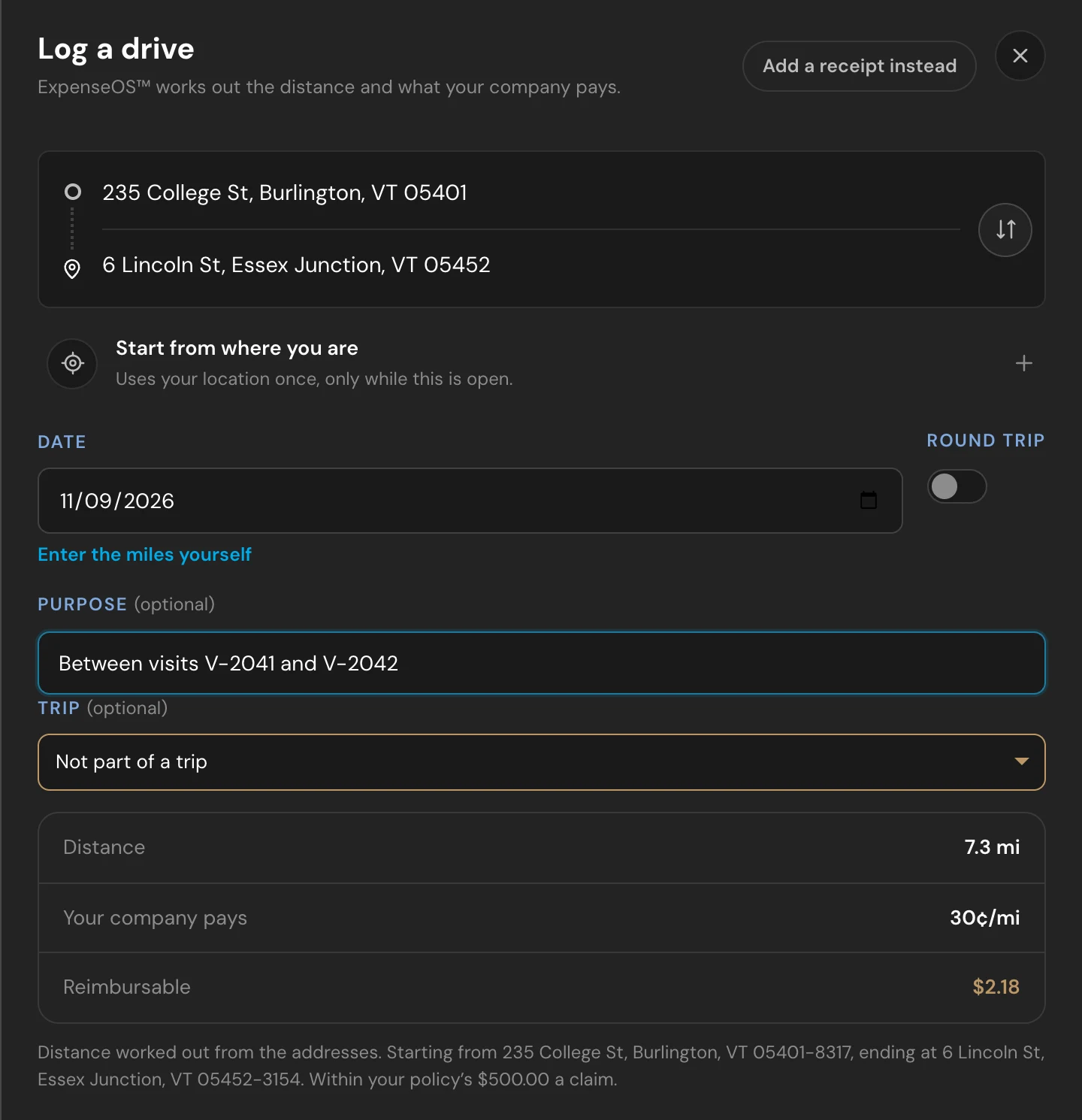
A real screen from the app: a drive between two visits, at the agency’s own rate. Two public libraries stand in for patients’ homes.
Each drive is paid at the rate in effect on its date, the IRS rate or your agency’s own, so a June drive filed in July is still paid at June’s rate; if your rate is above the IRS rate, the drive shows how much is above it and may count as taxable income.
Receipts are snapped, uploaded or emailed to each person’s own receipts address and read for the merchant, amount and category. Expenses inside your policy approve themselves; anything else goes to a manager with what was checked. Once approved, the money is in the caregiver’s ExpenseOS wallet within a minute, ready to move to their bank in one to three business days.
Someone on your finance team, in the Accountant role, gives each approved expense its GL code and a cost center, such as a branch or a program, and exports the lines as CSV or Excel; coded expenses post to QuickBooks, Xero, NetSuite, Sage Intacct and Microsoft Dynamics. ExpenseOS pays the miles, not the drive time, which goes through your payroll: it doesn’t connect to scheduling, EVV or payroll systems today. How home health and home care agencies use ExpenseOS →
This guide is general information as of 9 November 2026, not legal or tax advice. Check your policy with a tax adviser and, for wage and state rules, employment counsel.