When do the FAR’s travel rules apply?
Wherever its cost principles do: in reimbursable costs on cost-reimbursement contracts and on the cost-reimbursement portion of time-and-materials contracts, where travel counts as an other direct cost (FAR 16.601); in indirect cost rates, which carry the travel in your overhead and G&A; and in pricing whenever cost analysis is performed (FAR 31.103; 31.102). Firm-fixed-price work priced without cost analysis isn’t billed trip by trip.
On cost-type contracts, allowability is judged under “subpart 31.2 in effect on the date of this contract” (FAR 52.216-7), and more than 30 agencies have adopted the Revolutionary FAR Overhaul’s rewritten Part 31 by class deviation (deviation text), the Defense Department from February 1, 2026 (2026-O0032). The two texts’ travel rules read much the same; this guide notes where they differ.
What should a contract travel request record?
Travel costs are allowable only if three things are documented (FAR 31.205-46(a)(7)), and the contractor’s records must show that costs claimed “have been incurred, are allocable to the contract, and comply with applicable cost principles” (FAR 31.201-2(d)). So before anyone books, ask for what an auditor will later need:
| Record | Why |
|---|---|
| The traveler’s name and title | The FAR’s “title or relationship to the contractor” |
| Dates and places, by city | The date and “city, town, or other similar designation” of each expense, which set the per diem |
| The purpose | In words an auditor can follow a year later |
| The contract or charge number | The contract the cost is allocable to, or its indirect account |
| Estimated cost by category | Airfare, lodging, meals and incidentals, and ground transport, against the per diem |
Approve it before booking, with approval levels by amount, and never let anyone approve their own trip. File who approved it, when and what they approved with the request.
What is the per diem ceiling, and where do the rates come from?
Lodging, meals and incidentals are allowable “only to the extent that they do not exceed on a daily basis the maximum per diem rates in effect at the time of travel” (31.205-46(a)(2)). GSA sets the rates for the 48 contiguous states and DC, the Defense Department for Alaska, Hawaii and other non-foreign areas, and the State Department for foreign countries (DTMO; State Department).
From October 1, 2026, GSA’s standard rate is $113 a night for lodging, before taxes, and $68 a day for meals and incidentals, and 295 places have higher rates (GSA Bulletin FTR 27-01). Federal travelers get 75% of the meals and incidentals rate on the days they leave and return, $51 at the standard rate (41 CFR 301-11.101).
DCAA treats the ceiling as one daily figure, “a total of lodging plus meals and incidental expenses” (DCAA guidebook, 72-1.3). Without lodging, or on partial days such as the days you leave and return, the maximum “generally would not constitute a reasonable daily charge”: reduce it, by the federal 75% or any method with a reasonable result (31.205-46(a)(6)). DCAA presumes a fixed per diem within the rates reasonable without detailed receipts; repaying actual costs means finding and excluding items such as alcohol.
A hotel’s going rate doesn’t raise the ceiling. A market price isn’t a contract’s limit: the per diem, an approved exception and the contract’s own terms decide what can be charged.
How do you document a stay above per diem?
Actual costs above per diem are allowable “in special or unusual situations,” up to the higher amounts federal employees may be paid, when all four conditions in 31.205-46(a)(3) are met:
| Condition | Keep on file |
|---|---|
| A situation the federal rules list, such as a conference hotel, a special event that has driven up prices nearby, or mission requirements | Which one, and the rates you found (41 CFR 301-11.300) |
| A written justification approved by “an officer of the contractor’s organization or designee” | The justification and its approval |
| A receipt for each expenditure of $75 or more | The itemized hotel bill and other receipts |
| The contracting officer’s advance approval for repeated use in one area | That approval |
The federal ceiling under actual expense is 300% of the maximum per diem rate, $543 a day at the standard rate (41 CFR 301-11.303). Approve the justification before booking, while there’s a cheaper room to compare. The overhaul’s Part 31 says “unusual situations” and “an official of the contractor’s organization,” so check which text each contract follows.
When can airfare cost more than the lowest fare?
Airfare above “the lowest priced airfare available to the contractor during normal business hours” is unallowable unless the cheapest fare would mean circuitous routing, unreasonable hours, excessively prolonged travel, costs that offset the savings, seats not reasonably adequate for the traveler’s physical or medical needs, or a fare that can’t meet mission requirements, and the reason is “documented and justified” (31.205-46(b)). Keep the fares offered when you booked and, for anything higher, the exception and who approved it.
On international flights under the Fly America clause, use U.S.-flag airlines where available, or explain why on the voucher (FAR 52.247-63). Mileage can be paid at a mileage rate, actual cost or a mix, if the result is reasonable (31.205-46(a)(1)); GSA’s rate for federal travelers and the IRS business rate are both 76 cents a mile from July 1, 2026 (GSA; IRS).
What receipts should you keep?
Above per diem, the FAR wants a receipt for each expenditure of $75 or more (31.205-46(a)(3)(iv)); the IRS wants one for every night of lodging and any other expense of $75 or more (Treas. Reg. 1.274-5(c)(2)(iii)). A hotel bill works when it shows the “name, location, date, and separate amounts for charges such as for lodging, meals, and telephone”; a restaurant receipt, its name, the date and amount, the number of people served and any charge that isn’t food or drink.
Ask for itemized receipts, not card slips: alcohol has to be visible before it can be taken out. Scans work on contracts with an audit and records clause if your imaging is reliable and indexed and the paper is kept a year after imaging (FAR 4.703(c)).
How do you keep unallowable costs out of billings?
Alcohol is unallowable (FAR 31.205-51), and so is entertainment, with “any directly associated costs such as tickets to shows or sports events, meals, lodging, rentals, transportation, and gratuities” (31.205-14). Expressly unallowable costs must be “identified and excluded from any billing, claim, or proposal applicable to a Government contract” (31.201-6).
Give each its own account, such as alcohol, entertainment and meals with guests, so the exclusion happens in the books, not at year end. A receipt that mixes allowable and unallowable items is split, or charged in full to the unallowable account. Unallowable indirect costs left in a final indirect cost rate proposal can bring penalties on most contracts over $1 million (FAR 42.709-1; DCAA CAM 6-107).
A meal for government employees is also a gift. Executive branch employees may accept unsolicited gifts of $20 or less per source per occasion and $50 a year from any one person, never cash, counting a company and its employees as one person (5 CFR 2635.204(a)).
How should each expense be coded?
To its cost objective: the contract’s charge number when the trip is for that contract, an indirect account when it isn’t, an unallowable account when it can’t be charged to either. Treat the same kind of cost the same way every time: nothing is charged direct to a contract if costs for the same purpose in like circumstances sit in an indirect pool (FAR 31.202(a)). Put the charge number on every line of the trip.
Does an approved trip mean the government will pay?
Not by itself. Your approval is an internal control: it shows the cost was planned, priced and authorized first. Whether it’s allowable and allocable on a contract is an accounting determination you make under that contract and its cost principles, and the government reviews it. “No presumption of reasonableness shall be attached to the incurrence of costs by a contractor”: if a cost is challenged, the contractor must establish that it’s reasonable (FAR 31.201-3(a)), and costs “inadequately supported” can be disallowed (31.201-2(d)). The file is your proof.
How long should the records be kept?
On contracts with an audit and records clause, 3 years after final payment or, for certain records, the periods in FAR 4.705, whichever expires first, and longer where a clause says so (FAR 4.703). Keep each trip’s file together.
What does an auditor usually ask for?
DCAA audits whether claimed costs are “Allowable, reasonable, and allocable to the contract under FAR 31,” and whether other direct costs, such as contract travel, are “supported by adequate documentation” (CAM 6-102.1, 6-106). Its travel guidance reviews your policies and procedures, individual trips, and “adequate controls for segregating unallowable travel costs” (72-1.1). Expect to show, for sampled trips, the request, approval, receipts, any justification and where each line was charged, and your procedures for excluding unallowable costs (FAR 52.216-7(d)(2)(iv)(E)).
What does one trip’s file look like?
Liam Park, an operations engineer at a 120-person engineering services company in Burlington, Vermont, works on a cost-reimbursement contract for depot maintenance, charge number CT-0417. In November he asked to visit the depot in Warner Robins, Georgia, from Tuesday to Thursday, December 8 to 10, 2026. Warner Robins takes GSA’s standard rate: $113 a night and $68 a day, $51 on the first and last days (GSA).
A conference had filled the hotels near the depot at $113 or less; the nearest room was $159, and cheaper ones were far enough away that the driving would eat the savings. So his request carried a written justification, approved before booking by the company’s vice president of finance, an officer. Meals were paid at per diem. On Wednesday he took two engineers from a subcontractor to dinner: $186.40 with tax and tip, $54.00 of it wine.
| Item | Paid back | Charged to | On file |
|---|---|---|---|
| Flight, Burlington to Atlanta and back | $468.20 | CT-0417 | Receipt and the fares offered |
| Rental car and fuel, 3 days | $214.37 | CT-0417 | Rental and fuel receipts |
| Drive to the airport and back, 46 miles at 76¢ | $34.96 | CT-0417 | Date, route and miles |
| Airport parking, 3 days | $36.00 | CT-0417 | Receipt |
| Hotel, 2 nights at $159, with taxes | $375.70 | CT-0417 | Itemized bill and the approved justification |
| Meals and incidentals at per diem | $142.00 | CT-0417 | Dates and city |
| Dinner with two guests, wine included | $186.40 | Company | Itemized receipt and the guests’ names |
Liam was paid back $1,457.63 ($468.20 + $214.37 + $34.96 + $36.00 + $375.70 + $142.00 + $186.40): $1,271.23 charged to CT-0417 and $186.40 to the company’s unallowable account. His meals were $51.00 on Tuesday and Thursday and $40.00 on Wednesday, $68 less GSA’s $28 for dinner, because the company paid for that dinner.
Both nights were above the daily ceiling, so the officer’s approved justification is what supports charging the hotel to the contract. Had Liam picked the room only because he liked it, the $46 a night above the rate would have been his or the company’s, not the contract’s. (Liam, his company, the contract and the numbers are made up.)
How does ExpenseOS™ handle contract travel?
People ask before they book or spend, in the chat (“Will this be approved?”) or with a request saying what it’s for, and ExpenseOS answers against your policy, naming the rule. Inside it, it’s approved in advance at once; otherwise it goes to an approver by your approval levels, or to one person you name, such as an officer.
A trip can be billed to a contract the person works on, and the contract has its own travel policy from the government contractors pack: economy airfare, hotels a night, ground transport and meals a day, each up to an amount you set. A hotel, flight, car or trip budget for the trip is checked against it, and the answer names the contract: “$46.00 a night over Depot maintenance contract’s hotel limit.” The hotel limit is one amount, not GSA’s rate for each city and month.
A trip’s budget can be approved in advance with its reason written in, such as “Hotels at the GSA rate are sold out; the nearest is $159 a night.” ExpenseOS keeps the request, the reason, what was checked, who approved it, and the receipts; expenses filed to the trip then go through until the budget is used.
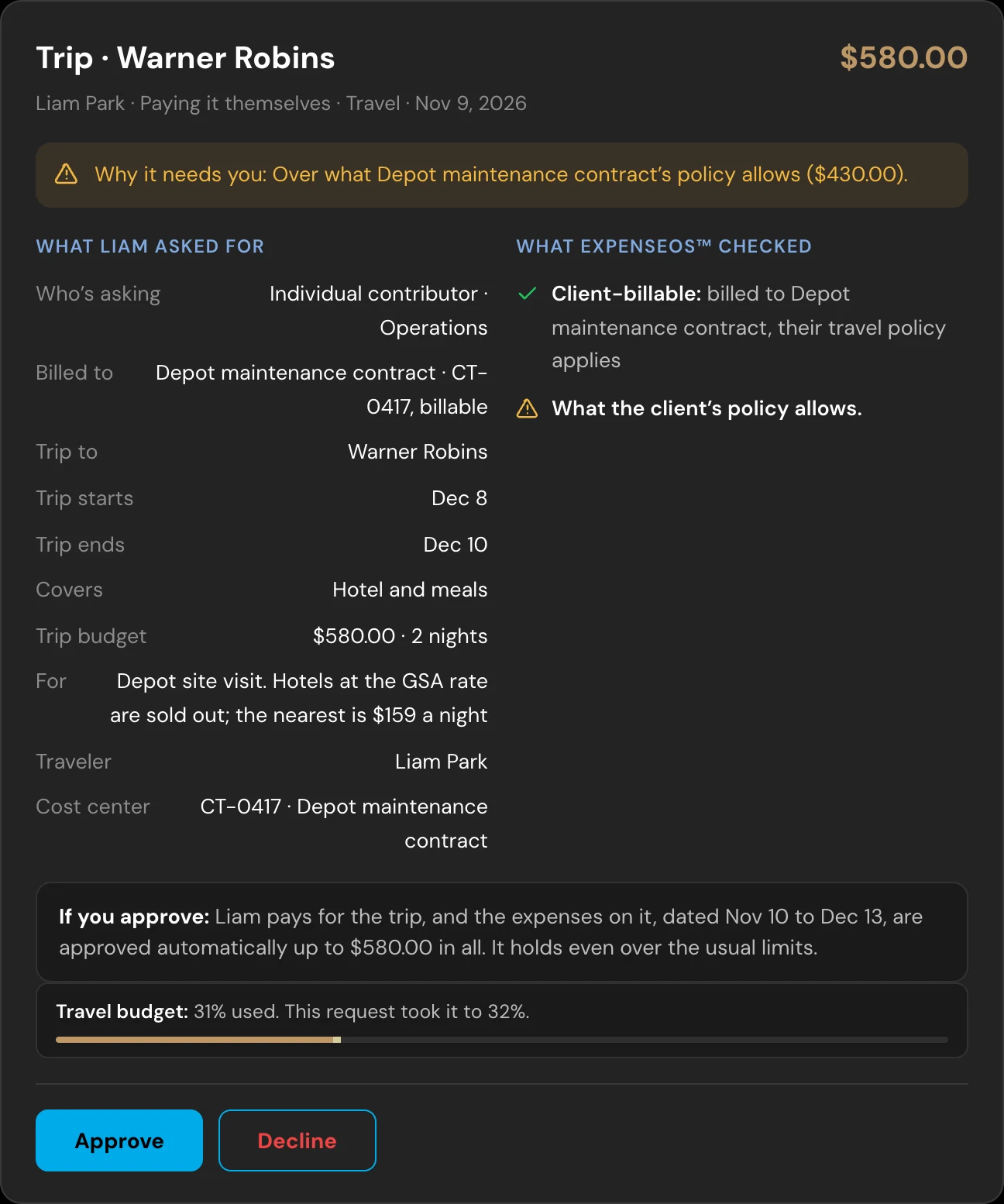
A real screen from the app: a contract trip’s budget, its written reason and what was checked, as the approver sees it.
Receipts are read and checked against your company’s policy, and one filed to a contract trip doesn’t carry the contract’s code: someone on your finance team, in the Accountant role, gives each expense a GL code and one cost center, such as the contract, and categories such as meals with guests can map to accounts of their own. ExpenseOS doesn’t split a mixed receipt, flag or decide allowability, compute indirect rates, keep time, prepare incurred cost submissions or bill the government.
It works beside your accounting, with no link to government, contractor accounting or timekeeping systems: lines export as CSV or Excel, and coded expenses post to QuickBooks, Xero, NetSuite, Sage Intacct and Microsoft Dynamics. Approved money lands in the employee’s ExpenseOS wallet within a minute, and per diem at GSA’s rates for each city and month is coming. Expense management for government contractors →
This guide is general information as of 9 November 2026, not legal or tax advice. Check your policy and your contracts with a government contracts accountant and your tax adviser and, for state reimbursement rules, employment counsel.