Can employees expense AI and software subscriptions?
Yes, when the tool is for their work; an AI assistant is a business expense like any other. Repaid under an accountable plan, the money stays out of the employee’s income and W-2 wages (Treas. Reg. 1.62-2(c)).
The harder question is data: an individual plan is the employee’s own account, which the company usually can’t see into or close. So tools that touch company code, customer data or company sign-in need a review before anyone buys.
What should come with a software receipt?
Software falls under the general substantiation rule, not section 274(d)’s stricter one for travel, gifts and listed property (26 U.S.C. 274(d)): enough “to identify the specific nature of each expense and to conclude that the expense is attributable to the payor’s business activities,” and no broad labels such as “miscellaneous business expenses” (Treas. Reg. 1.62-2(e)(3)). Ask for:
| What to record | Why |
|---|---|
| Vendor and plan | The specific nature of the expense |
| Billing period and renewal date | Monthly or annual, and when it renews |
| Seats | Whether anyone else uses it |
| Business purpose | The project, team or customer it’s for |
| Company or customer data? | Whether it needs a security review or a company account |
Who should approve recurring software?
A manager, before the first charge: a $30 monthly plan costs $360 a year and renews on its own. Let individual tools under a monthly limit approve themselves, send anything recurring above it and every annual plan to a manager, and send tools that touch code, customer data or sign-in to whoever runs security.
Put it in writing. Illinois holds an employer only to expenses it “authorized or required,” or where it failed to comply with “its own written expense reimbursement policy” (820 ILCS 115/9.5).
When should a subscription move to a company account?
When it stops being one person’s tool; any one of these is enough. The company then pays the vendor and personal plans end:
| When | What to do |
|---|---|
| Two or three people use it | Buy seats on a company plan instead of repaying each person |
| It holds company code, customer data or confidential documents | Keep that data in an account the company controls |
| A security review asks for admin control | Control access, data retention and closing accounts when people leave |
| The plan’s terms don’t fit business use | Read them first: who the license covers, whether business use is allowed, whether what people type can train the vendor’s models |
What if one subscription is for work and personal use?
Repay the business share only: the accountable-plan rules cover business expenses (Treas. Reg. 1.62-2(d)), so anything paid for personal use is taxable pay. If most of the use is work, a company seat is cleaner than splitting a bill every month.
Who owns equipment bought for a remote employee?
Whoever the policy says, so say it before anyone buys: equipment the company buys or repays is company property, listed, and returned when someone leaves, at the company’s cost to ship.
Check state law before docking a final paycheck for unreturned equipment. For the non-exempt staff it covers, California’s wage order for professional, technical and clerical jobs allows that only “with the prior written authorization of the employee,” never for “normal wear and tear,” and not for loss or breakage short of dishonesty, willfulness or gross negligence (IWC Order 4-2001, sections 1, 8 and 9). Federal law sets a floor for non-exempt staff too: the cost of “tools of the trade” a job requires them to provide can’t cut into minimum wage or overtime (29 CFR 531.35).
Can a startup expense equipment under the de minimis safe harbor?
Yes, up to a limit. The safe harbor lets a company deduct small purchases of tangible property that would otherwise be capitalized (Treas. Reg. 1.263(a)-1(f)): up to $2,500 per invoice, or per item as substantiated by the invoice, without an applicable financial statement (the regulation says $500; Notice 2015-82 raised it from 2016), and $5,000 with one, such as a certified audit used for credit or reporting to shareholders, which a funded startup may have.
It takes three things: accounting procedures in place at the start of the tax year that expense property costing less than a set amount (written ones, with an applicable financial statement); the item booked as an expense under them; and each year’s election, a statement titled “Section 1.263(a)-1(f) de minimis safe harbor election” attached to the timely filed original return, which then covers every qualifying purchase that year. Delivery charged on the same invoice counts toward the limit, and invoicing one item in pieces to get under it falls to an anti-abuse rule.
Do you have to reimburse remote employees’ internet and phone?
In some states. California’s Labor Code section 2802 requires employers to indemnify employees for “all necessary expenditures or losses” incurred in direct consequence of their duties, and an agreement to waive it is “null and void” (section 2804). In Cochran v. Schwan’s Home Service (2014), California’s Court of Appeal held that employees who must use personal cell phones for work calls are owed “a reasonable percentage of their cell phone bills,” on unlimited plans too. Home internet wasn’t at issue; ask employment counsel.
Illinois (820 ILCS 115/9.5) requires repaying necessary expenditures, claimed within 30 days unless a written policy allows longer, and lets a written policy set limits short of “no reimbursement or de minimis reimbursement.” Montana (39-2-701) and South Dakota (60-2-1) impose California’s duty in similar words; Iowa (91A.3) and New Hampshire (RSA 275:57) require expenses the employer authorized or asked for to be repaid within 30 days of the claim.
How you pay decides the tax. A flat stipend with no bill behind it is taxable wages, since an accountable plan needs each expense substantiated (Treas. Reg. 1.62-2(c) and (e)); the business share repaid against the bill isn’t. For a personal phone the job requires, IRS examiners won’t necessarily treat a repayment as wages if the plan fits the work, it’s “reasonably calculated so as not to exceed expenses the employee actually incurred” and it doesn’t replace wages (IRM 4.23.5.15.3.2).
Approval rules or license reviews: what catches duplicate subscriptions?
Approval decides what’s visible at purchase: whether a tool is for work, inside the limit, safe for company data and not already paid for. It can’t see what comes later: the same tool bought by two teams months apart, a seat left unused, an annual plan renewing unopened. SaaS management software watches sign-ins and vendor accounts to find duplicate and unused licenses; an expense policy doesn’t.
So add a quarterly license review: export the software expenses by vendor and cost center, list each tool’s owner, seats and renewal date, ask owners whether every seat was used, and cancel, downgrade or combine before the next renewal.
What does a remote engineer’s month look like?
Theo, a backend engineer at a 40-person startup, works from home in Denver. His company’s policy approves software up to $50 a month and equipment up to $500 an item automatically, reviews tools that read company code, and has IT order computers. In October 2026 his manager approved a $2,100 budget for a conference in Austin: hotels up to $300 a night, meals up to $75 a day.
| Expense | Paid back | Approval |
|---|---|---|
| AI coding assistant, $39 a month | $39.00 | Security review: it reads company code |
| Technical book library, $15 a month | $15.00 | Automatic |
| 27-inch monitor | $429.00 | Automatic |
| Laptop, $2,399 | $0.00 | IT orders it |
| Registration $899, flights $386, two nights at $279 | $1,843.00 | Trip budget |
| Meals, $62 and $81 | $137.00 | Automatic, up to $75 a day |
| Rideshares, airport and hotel | $54.00 | Trip budget |
| Drive to the airport and back, 46 miles × $0.76 | $34.96 | Automatic, at the IRS rate from July 1, 2026 |
Theo is paid back $2,551.96: $54.00 of software, the $429.00 monitor and $2,068.96 for the trip ($1,843.00 + $137.00 + $54.00 + $34.96). He covers $6 of meals above the daily limit; the laptop never touches his card.
The coding assistant moves to a company plan in November: Theo is the third engineer paying for it, and three is the policy’s trigger. The monitor and laptop each cost under $2,500, so a company that elects the de minimis safe harbor, and books them as expenses, can deduct both this year. (Theo, his company and the numbers are made up.)
How does ExpenseOS™ handle software, equipment and travel?
Employees ask before they spend: “Will this be approved?” in the chat, or an approval in advance they can track, which lets the matching expense go through on its own. The agent answers against your policy with the rule named.
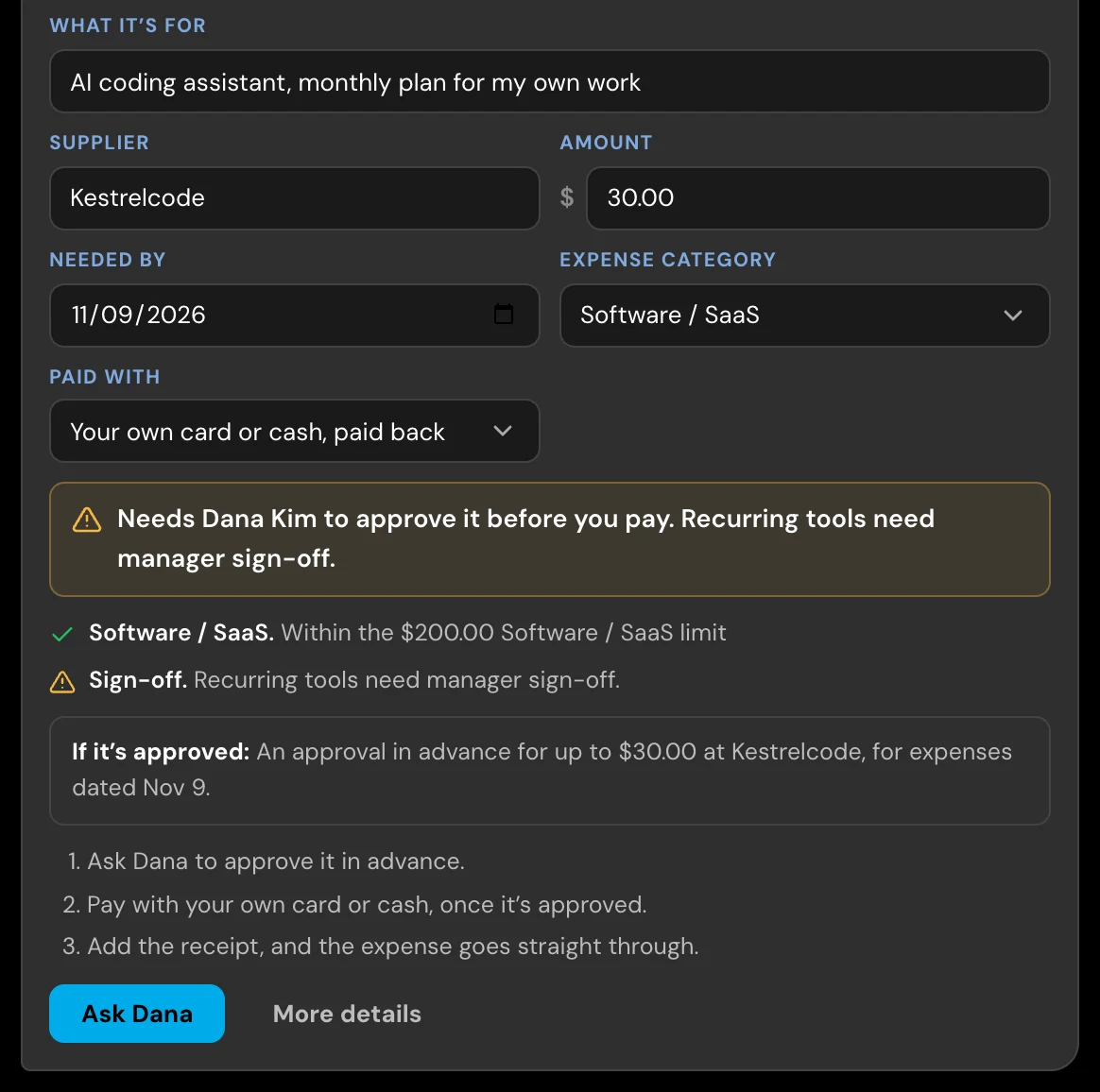
A real screen from the app: the answer to “Will this be approved?” for a $30-a-month AI coding assistant, with the company’s rule for recurring tools named.
Each category carries your limits and rules, such as a monthly limit for software and a manager’s sign-off on recurring tools. Expenses inside the policy approve themselves; anything else goes to a manager with what was checked. Receipts are snapped, uploaded or emailed to each person’s own receipts address and read for the merchant, amount and category.
A trip groups its flights, hotel, meals, rides and drives, and its budget can be approved in advance so the expenses on it go through. Once approved, the money is in the employee’s ExpenseOS wallet within a minute, ready to move to their bank in one to three business days.
Someone on your finance team, in the Accountant role, gives each expense its GL code and a cost center and exports the lines as CSV or Excel; coded expenses post to QuickBooks, Xero, NetSuite, Sage Intacct and Microsoft Dynamics. ExpenseOS doesn’t detect duplicate subscriptions or unused licenses and isn’t a SaaS management tool: it enforces your policy on each purchase. How software and technology companies use ExpenseOS →
This guide is general information as of 9 November 2026, not legal or tax advice. Check your policy with a tax adviser and, for wage and state rules, employment counsel.