What should a trip request include?
Enough for an approver to judge the trip before money is spent. For travel away from home, an accountable plan needs each expense’s amount, time, place and business purpose (Treas. Reg. 1.62-2(e)(2)), so ask for them up front:
| Ask for | Why |
|---|---|
| The purpose: the agenda, or the study, site and visit type | The “business reason for travel” (Treas. Reg. 1.274-5T(b)(2)), and what the approver judges |
| Destination and dates | The window the approval covers |
| Project or cost center | Which budget pays, and whether federal money does |
| Cost by category | Registration, airfare, hotel, meals and rides, so the approval has a ceiling |
| Who else is going | So the team decides how many people a congress needs |
Set approval levels by amount, and never let anyone approve their own trip.
Should you approve a trip budget or each purchase?
Approve the trip once: a budget for its travel and meals, its dates and its amount means nothing inside it needs another decision, and the approver decides what matters, whether the trip is worth taking. Approve on their own what the budget didn’t foresee, such as a fare above the policy, and anything outside the trip’s dates, above what’s left or of another kind, such as a meal with healthcare professionals.
How should conference registration, airfare and hotels be handled?
Registration
Approve it with the trip, before the early rate closes, and keep the agenda: “The convention agenda or program generally shows the purpose of the convention” (IRS Publication 463). Meals included in the registration aren’t claimed again.
Airfare
Book economy at the lowest logical fare, the cheapest that fits the schedule with a reasonable routing, and set an advance-booking rule, such as 14 days ahead and 21 for international flights. If you allow premium economy on long flights, write the number of hours into the policy.
Hotels and conference blocks
A block saves time near the venue but isn’t always the best rate, so compare it with the city’s going rate for those dates and with your cap, which can follow each city’s rates rather than one figure everywhere. Keep the itemized bill: a hotel receipt works if it shows the “name, location, date, and separate amounts for charges such as for lodging, meals, and telephone” (Treas. Reg. 1.274-5(c)(2)(iii)(B)).
Extra days, guests and congresses abroad
On a trip in the United States that’s primarily for business, a vacation added at the end leaves “only your business-related travel expenses” deductible, the fare to and from the destination included (Publication 463), so pay for the business days. A spouse’s or guest’s travel isn’t deductible unless they’re an employee traveling for a bona fide business purpose (IRC 274(m)(3)), and a congress outside the North American area has its own test (274(h)) for your tax adviser.
What shows the business purpose of a research-site visit?
The study does. A drug sponsor “shall monitor the progress of all clinical investigations being conducted under its IND” (21 CFR 312.56), and a device sponsor is responsible for “ensuring proper monitoring of the investigation” (21 CFR 812.40), so qualification, initiation, monitoring and close-out visits are plainly business travel.
Put the protocol number, site number and visit type in the request, and keep the visit confirmation and report with your clinical records. A written statement of business purpose is generally required, but “Where the business purpose is evident from the surrounding facts and circumstances, a written explanation of such business purpose will not be required” (Treas. Reg. 1.274-5T(c)(2)(ii)(B)), and a protocol and site number make it evident. Keep participants’ names and study data out of expense notes.
How are travel meals different from meals with healthcare professionals?
Travel meals are the traveler’s own, capped by the day or paid as a per diem. A meal with healthcare professionals is a meal with guests, for a business purpose, under per-person limits your compliance team sets, with everyone who ate recorded. The codes shape those limits: the PhRMA Code keeps speaker-program meals “modest as judged by local standards” and says companies “should not pay for or provide alcohol in connection with the speaker program”; the AdvaMed Code allows occasional modest meals and bars entertainment “in any form”; and the HHS Inspector General lists alcohol and “a meal exceeding modest value” among speaker programs’ suspect characteristics (2020 Special Fraud Alert).
States go further: Vermont bars most gifts and meals from manufacturers of prescribed products to Vermont health care providers (18 V.S.A. 4631a), Minnesota limits drug makers’ and wholesalers’ gifts to a practitioner to $50 a year (§151.461), and New Jersey caps the meals its prescribers may accept from drug makers (N.J.A.C. 13:45J-1.2).
An applicable manufacturer, broadly one making a drug, device, biological or medical supply that Medicare, Medicaid or CHIP pays for, or supporting one under common ownership (42 CFR 403.902), reports these meals to CMS. A shared meal whose individual costs can’t be separated is valued by “dividing the entire cost of the food or beverage by the total number of individuals who partook in the meal” (42 CFR 403.904(g)), and in 2026 a payment under $13.82 is excluded unless the recipient’s total for the year passes $138.13 (CMS). That reporting is your compliance team’s work, from the attendee records your policy requires.
What does an accountable plan need?
Each expense is for the business, accounted for within a reasonable time, and any excess is returned; reimbursements then stay out of wages and employment taxes (Treas. Reg. 1.62-2(c)(4)). Accounting within 60 days and returning any excess within 120 count as reasonable (1.62-2(g)). Keep a receipt for every night of lodging and every other expense of $75 or more (Treas. Reg. 1.274-5(c)(2)(iii)).
Some states add rules: California requires employers to indemnify employees for “all necessary expenditures or losses” incurred in direct consequence of their duties (Labor Code 2802), and Illinois has employees submit within 30 days unless a written policy allows longer, with a signed statement for a missing receipt (820 ILCS 115/9.5).
When do federal travel rules apply?
Only on trips charged to a federal award or contract. Code those trips to the award, and charge anything above the federal limits to company funds.
Grants and other federal awards
Travel may be charged at actual cost, per diem or mileage, “provided the method used is applied to an entire trip and not to selected days of the trip,” with lodging and meals inside your written policy and airfare above “the basic least expensive unrestricted accommodations class” only for a listed, documented reason (2 CFR 200.475). Agencies apply these rules to companies only as their regulations allow (2 CFR 200.101); NIH holds for-profit organizations to the FAR’s cost principles instead (NIH Grants Policy Statement 7.2).
Federal contracts
Lodging, meals and incidentals are allowable only up to the federal per diem for the place, each day, unless an officer approves a written justification for a special situation; airfare above “the lowest priced airfare available to the contractor during normal business hours” needs a listed, documented reason (FAR 31.205-46); and the Fly America clause calls for U.S.-flag airlines on international flights where available (FAR 52.247-63).
Can you pay per diem instead?
Yes. A per diem paid in place of actual lodging, meals and incidentals counts as substantiated up to the federal rate for the place, if the traveler records the time, place and business purpose; anything above it is wages (Rev. Proc. 2019-48). From October 1, 2026, the federal rates are $113 a night before taxes and $68 a day in most of the continental United States, with 295 places at their own rates (GSA Bulletin FTR 27-01); San Diego’s are $208 a night in October and $86 a day (GSA). Travel days get 75% of the meals rate, $64.50 in San Diego (GSA), or another method you apply consistently. The IRS high-low method is $329 a day in high-cost places and $230 elsewhere (Notice 2026-60).
How should trips be coded?
Give every trip one cost center, the study for a site visit and the department or product program for a congress, and code meals with healthcare professionals to a GL account of their own so your compliance team can find them. A trip charged to a federal award carries the award’s code.
What do a congress trip and a site visit look like?
Nadia, a clinical scientist at a 90-person medical device company in Boston, made two trips in October 2026. Her company’s policy: economy booked 14 days ahead, hotels up to $300 a night before taxes, her own meals up to $90 a day, and $65 a person for lunch with healthcare professionals. Her manager approved a $2,800 budget for a scientific congress in San Diego, October 19 to 22, coded to medical affairs with the agenda attached, and a $900 budget for a monitoring visit at a Houston hospital running the company’s device study, October 27 and 28, coded to the study, CS-07.
| Expense | Coded to | Paid back |
|---|---|---|
| Congress registration | Medical affairs | $940.00 |
| Flights to San Diego and back | Medical affairs | $468.40 |
| Congress hotel, 3 nights at $289, with taxes | Medical affairs | $1,003.73 |
| Her meals, 4 days ($6 over the limit left off) | Medical affairs | $243.00 |
| Rides, San Diego airport and hotel | Medical affairs | $79.00 |
| Flights to Houston and back | Study CS-07 | $412.60 |
| Hotel near the site, 1 night at $219, with taxes | Study CS-07 | $256.23 |
| Her meals, 2 days | Study CS-07 | $73.00 |
| Rides, Houston airport and site | Study CS-07 | $101.00 |
| Lunch for the site team, 3 people | Study CS-07 | $66.00 |
Nadia is paid back $3,642.96: $2,734.13 for the congress ($940.00 + $468.40 + $1,003.73 + $243.00 + $79.00), inside its $2,800 budget; $842.83 for the site visit’s travel ($412.60 + $256.23 + $73.00 + $101.00), inside its $900 budget; and $66.00 for the lunch, approved on its own as a meal with healthcare professionals at $22.00 a person.
The block’s $289 was above San Diego’s federal lodging rate of $208, which matters only on federally funded travel; under the company’s $300 cap, it was in policy. A meals per diem at San Diego’s federal rate would have paid $64.50 + $86 + $86 + $64.50 = $301.00, without meal receipts. If the company reports under Open Payments, its compliance team works out the investigator’s share of the lunch. (Nadia, her company, the study and the numbers are made up.)
How does ExpenseOS™ handle conference and site travel?
People ask before they book or spend: “Will this be approved?” in the chat, or a request with what it’s for, the supplier, amount, date and category. ExpenseOS answers against your policy and names the rule. Inside the policy, it’s approved in advance at once; otherwise it goes to an approver by your approval levels, by amount, or to one person you name. A review your policy asks for, such as QA or IT review, sends the request to that approver; there’s no separate compliance queue.
A trip’s budget can be approved in advance: travel and meals filed to the trip and dated in its window go through until the budget is used, even above a category’s usual limit, and anything else is checked against your policy as usual. Travel search finds flights, hotels and cars and checks each against your policy; people book on the airline’s, hotel’s or rental company’s own site, with their own card.
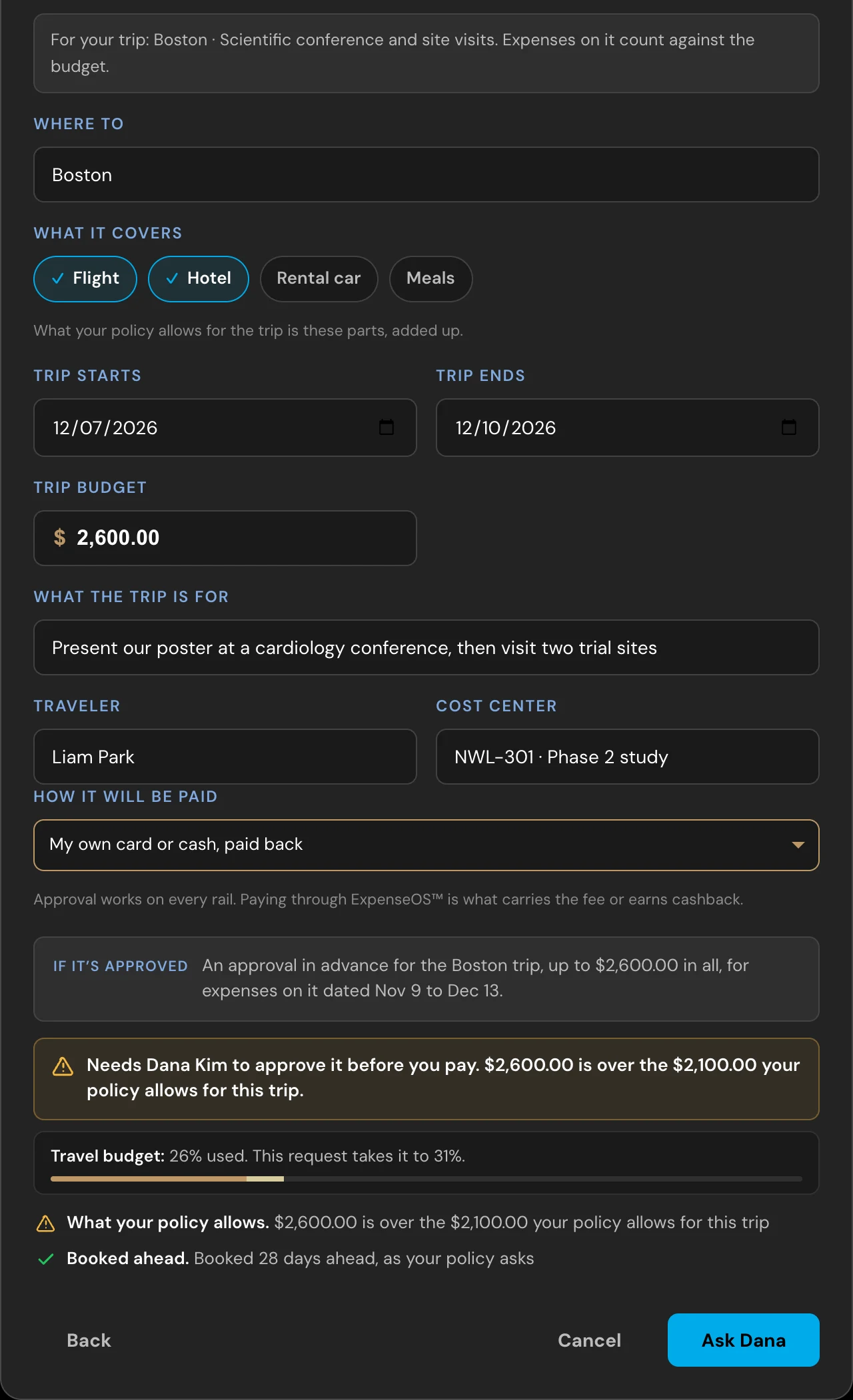
A real screen from the app: a trip budget asked for before booking, coded to the study, with the rule named.
The life sciences pack starts you with a category for meals with healthcare professionals, with per-person limits by meal, changed on screen or in a sentence. Asked about first as a meal with guests, a meal like that is checked against its limit before anyone spends, and the answer reminds people that your policy asks for the guest list. File it apart from any trip, since a trip’s budget covers the meals filed to it. ExpenseOS doesn’t yet record who attended, and doesn’t record NPI or license numbers, check whether a guest is a covered recipient, apply state rules your policy doesn’t contain or prepare Open Payments reports: those stay in your compliance team’s own records.
Receipts are snapped, uploaded or emailed, read and checked against your policy; expenses inside it approve themselves, and approved money reaches the employee’s ExpenseOS wallet within a minute. Someone on your finance team, in the Accountant role, gives each expense a GL code and one cost center, such as a study or a department; coded expenses post to QuickBooks, Xero, NetSuite, Sage Intacct and Microsoft Dynamics. Per diem at GSA rates is coming. Expense management for life sciences companies →
This guide is general information as of 9 November 2026, not legal or tax advice. Check your policy with a tax adviser, your rules for meals with healthcare professionals with your compliance officer and, for state reimbursement rules, employment counsel.