What makes an expense billable to a client?
The engagement letter or contract decides. Billable expenses are costs the client agreed to pay for its own work, usually travel and other out-of-pocket costs; a good letter says which, at cost or with a markup, under what caps (the client’s travel policy, or the federal per diem), with which receipts, and how soon they’ll be billed.
Firm overhead, such as rent, insurance and shared software, isn’t billable; your fees cover it. For lawyers that’s an ethics rule: ABA Formal Opinion 93-379 bars billing clients for the overhead of running an office, and allows in-house services, such as copying, at actual cost or, under the comment to Model Rule 1.5, a reasonable amount agreed in advance. It’s a sound default for any firm.
Can a firm mark up expenses it bills to clients?
Only if the client agreed. Model Rule 1.5(b) has lawyers explain, preferably in writing, which expenses clients will pay, and ABA Formal Opinion 512 restates 93-379 for costs paid to others, such as travel: bill the actual cost, pass along discounts and, unless the client was told otherwise, the lawyer “should not add a surcharge.” Other firms aren’t bound by those rules, so the engagement letter is what clients hold you to: state any markup there.
On federal contracts, the FAR caps lodging, meals and incidentals at the federal per diem (FAR 31.205-46) and makes alcohol unallowable (FAR 31.205-51). Government contractors →
Do you reimburse the employee if the client never pays?
Yes. Repaying your employee and billing your client are separate steps, with different rules and usually different systems. The firm repays its employee under its accountable plan: each expense has a business connection, is substantiated within a reasonable time, and any excess is returned (Treas. Reg. 1.62-2). None of that depends on a client paying, and the payments stay out of the employee’s income and W-2 wages.
An unpaid invoice is the firm’s to collect. Some states require reimbursement: California’s Labor Code section 2802 makes employers indemnify employees for “all necessary expenditures or losses” incurred in direct consequence of their duties. And since a 2025 law permanently barred most employees from deducting unreimbursed travel expenses (Notice 2026-10), what you don’t repay is their cost.
Who takes the 50% limit on meals billed to a client?
Business meals are deductible only if they aren’t lavish and someone from the firm is there, and then at 50% (IRC 274(k) and (n)). When one party pays for meals while working for another under a reimbursement arrangement, the limit applies to one of them, “but not to both” (Treas. Reg. 1.274-12(c)(2)(ii); 1.274-2(f)(2)(iv) is the same).
Between firm and employee, the firm takes it unless it treats the reimbursement as wages. Between firm and client, it goes to the party a written agreement expressly names; if none is named, to the client when a written agreement expressly says the client will reimburse expenses such as meals and the firm accounts for them as section 274(d) requires. Otherwise the firm keeps it, even if it sends receipts, as it does on any part of a meal the client doesn’t pay for.
So name meals in the letter and, for certainty, who takes the limit. Entertainment, such as game tickets, isn’t deductible (274(a)), and food at an event counts as entertainment unless it’s bought separately or shown separately on the bill (Treas. Reg. 1.274-11(b)(1)(ii)). Your employee isn’t taxed on the disallowed half (Treas. Reg. 1.62-2(h)(1)).
How do you keep billable expenses from being missed?
Tie the deadline to your billing cycle. The IRS treats an expense accounted for within 60 days as timely (Treas. Reg. 1.62-2(g)), but if you bill monthly, a hotel bill arriving in week seven has missed an invoice. Ask for billable expenses within a few business days of the trip, before the billing cutoff.
And make each one ready to bill on arrival: client and engagement code, a billable flag, the itemized receipt and the business purpose. Uncoded, it waits until someone works out whose it is; without a receipt, a client that asked for one can refuse it; after the invoice, it needs a supplementary bill, if the letter allows one. What never reaches the bill, the firm pays for.
What receipts and records should you keep?
The IRS requires documentary evidence, such as a receipt, for all lodging and any other expense of $75 or more (Treas. Reg. 1.274-5(c)(2)(iii)). An adequate hotel receipt lists room, meals and phone charges separately; a restaurant’s shows the date, amount and number of people served. For a business meal, also record who attended and their company, since the deduction depends on someone from the firm being there with business associates (Treas. Reg. 1.274-12(a)). Clients may ask for more.
Photos and scans count if your system meets Rev. Proc. 97-22: accurate, complete copies, controls against unauthorized changes, indexing and legible reproductions; using someone else’s system doesn’t shift that duty. Once it’s tested and has procedures to stay compliant, the paper can go.
Keep records supporting a deduction generally for three years from filing the return (Publication 463), and employment tax records for at least four (IRS).
How should you pay and bill mileage on client work?
Pay up to the IRS rate for the date of the drive: 72.5 cents a mile from January 1 to June 30, 2026 (Notice 2026-10), and 76 cents from July 1 (Announcement 2026-11). More is taxable pay. Bill at the letter’s rate.
Home to your regular office is commuting. But if you have a regular office, the round trip from home to a client site where the work is expected to last a year or less counts “regardless of distance” (Publication 463, following Rev. Rul. 99-7); a site you’ll work at for more than a year is commuting too. Drives between workplaces count, as do business parking and tolls and, on an overnight trip, the drive between home and the airport.
How do client travel policies and per diem caps work?
On a billable trip, apply the stricter of your policy and the client’s: what the client won’t pay, the firm absorbs. A practical cap is the federal per diem, which GSA sets by county and month. For travel from October 1, 2026 to September 30, 2027, the standard rate is $113 a night for lodging and $68 a day for meals and incidentals; 295 places have their own rates, with meals up to $92 (GSA Bulletin FTR 27-01).
Chicago is $92 a day for meals and incidentals, and $148 to $238 a night by month before taxes (GSA). On a trip’s first and last days, federal travelers get 75% of the meals rate, $69 in Chicago (GSA).
What does a two-day client trip look like?
Elena, a consultant at a Boston firm, flew to Chicago to work at Meridian Co on Tuesday and Wednesday, October 13 and 14, 2026. The engagement letter bills travel at cost: hotels up to $250 a night with taxes, the traveler’s meals up to the city’s federal meals and incidentals rate each day, mileage at the IRS rate, no alcohol. Her firm allows $300 a night and wine with clients, and with nothing nearby under $250, her manager approved $289. Tuesday’s dinner with two Meridian managers was $302.40 with tax and tip, $68.40 of it the wine’s share, so each person’s food came to $78.
| Expense | Paid back | Billed | Why |
|---|---|---|---|
| Flight, Boston to Chicago and back | $412.00 | $412.00 | Travel at cost |
| Hotel, one night with taxes | $289.00 | $250.00 | The client’s cap |
| Drive between home and the airport, 36 miles | $27.36 | $27.36 | 36 × $0.76, the IRS rate |
| Meals Tuesday: lunch $19, her dinner $78 | $97.00 | $92.00 | Chicago’s meals rate, $92 a day |
| Meals Wednesday: breakfast $14, lunch $22 | $36.00 | $36.00 | Under $92 |
| The guests’ dinners and the wine | $224.40 | $0.00 | Her meals only; no alcohol |
The firm pays Elena back everything, $1,085.76. It bills Meridian $817.36 and absorbs $268.40: $39 of the hotel, $5 of Tuesday’s meals and $224.40 for the guests and the wine. Had the letter followed the federal rules in full, Tuesday’s meals would be capped at $69 and the firm would absorb $23 more.
Meridian takes the 50% limit on the $128 of meals it pays, since the letter says it reimburses meals and the firm sends the receipts; the firm keeps it on the $229.40 it absorbs. Elena owes tax on none of it. (The names and numbers are made up.)
How does ExpenseOS™ handle client-billable expenses?
A trip can be billed to a client with its engagement code. Travel requested or booked for it is marked billable to that client and checked against the client’s travel policy instead of your firm’s, and the approver sees which client it’s billed to. Receipts and drives filed to the trip stay with it.
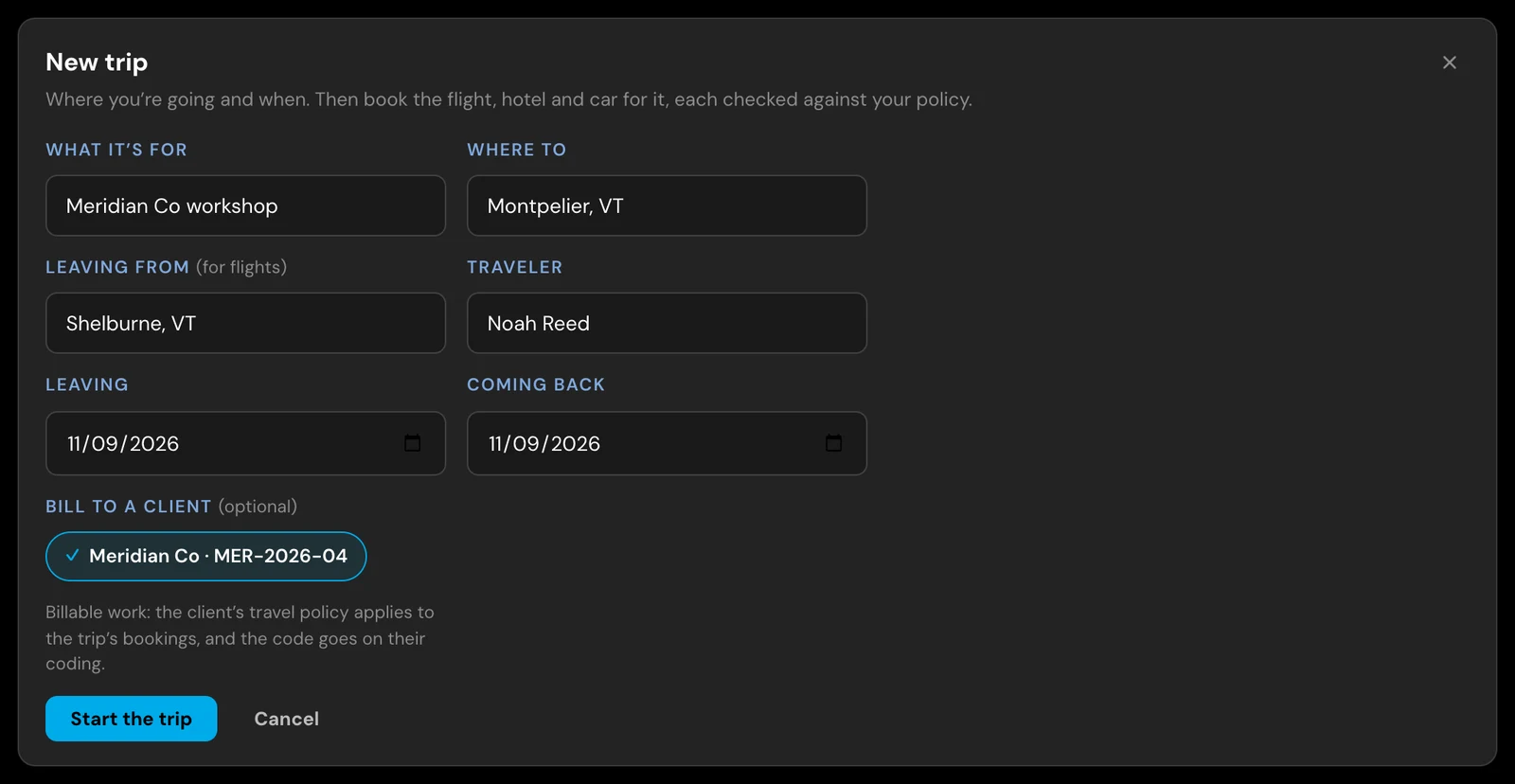
A real screen from the app: a trip billed to the client’s engagement.
Receipts are snapped, uploaded or emailed to each person’s own receipts address and read for the merchant, amount and category; drives are worked out from their addresses at the rate in effect on the date. Expenses inside your policy approve themselves, and anything else goes to a manager with what was checked. Once approved, the money is in the employee’s ExpenseOS wallet within a minute, ready to move to their bank in one to three business days.
Someone on your finance team, in the Accountant role, gives each expense its GL code and a cost center, such as the client engagement, and exports the lines as CSV or Excel (date, employee, merchant, category, amount, GL code, cost center), so a firm that bills by engagement has it on every line; coded expenses post to QuickBooks, Xero, NetSuite, Sage Intacct and Microsoft Dynamics. ExpenseOS doesn’t create client invoices: you bill clients from your own billing or accounting system. How professional services firms use ExpenseOS →
This guide is general information as of 9 November 2026, not legal or tax advice. Check your policy and engagement letters with a tax adviser, with employment counsel for state rules and, at a law firm, with ethics counsel.